UVA and UVB: Understanding the Differences and How Strategies UV Protection Is Tested

Sun exposure is one of the environmental factors that can affect the condition and health of the skin. Among the different types of ultraviolet radiation, UVA and UVB are the two types of radiation most commonly discussed in relation to skin protection.
Both have different characteristics, wavelengths, and effects on the skin. Therefore, understanding the differences between UVA and UVB is important when selecting and developing sunscreen products that provide optimal protection.
Table of Content:
- Why Is Protection Against UVA and UVB Important?
- SPF and PA: What Is Their Relationship with UVA and UVB?
- Why Is Laboratory Testing Important for Sunscreen Products?
Why Is Protection Against UVA and UVB Important?
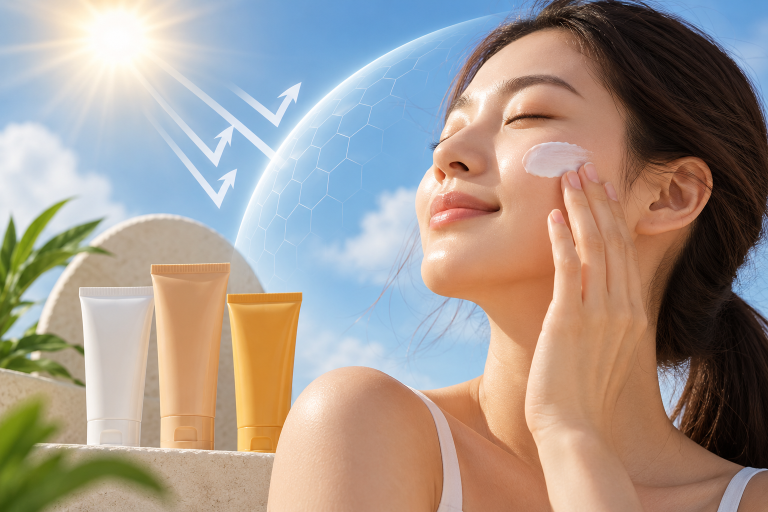
Ultraviolet (UV) radiation is part of solar radiation with shorter wavelengths than visible light. Based on their wavelengths, UV radiation can be classified into UVA, UVB, and UVC.
However, UVA and UVB are the types most relevant to everyday skin exposure. UVA has a wavelength range of approximately 320 to 400 nm and can penetrate deeper into the skin, reaching the dermis.
UVA exposure is primarily associated with photoaging, including the development of fine lines, wrinkles, and pigmentation changes. Meanwhile, UVB has a wavelength range of approximately 280 to 320 nm and primarily affects the epidermis. UVB is one of the main causes of sunburn resulting from sun exposure.
Read Also:
Strategies SPF Laboratory Test Results: What Do SPF 30, SPF 50, and SPF 50+ Mean?
SPF and PA: What Is Their Relationship with UVA and UVB?
SPF (Sun Protection Factor) is a commonly used parameter to describe the level of sunscreen protection, particularly against UVB radiation associated with erythema or sunburn. A higher SPF value generally indicates a greater level of protection against UVB based on the applicable testing method.
Meanwhile, PA is a labeling system associated with the level of UVA protection. Therefore, SPF and PA provide different information regarding the protective performance of sunscreen products. Effective UV protection should ideally address both UVA and UVB radiation.
Why Is Laboratory Testing Important for Sunscreen Products?
UV protection claims on sunscreen products should be supported by appropriate and measurable testing. Laboratory testing can be used to evaluate product performance based on established parameters and testing methods.
Testing may be conducted using either in vitro or in vivo approaches, depending on the parameter being evaluated and the applicable testing method. For manufacturers, sunscreen testing plays an important role in supporting claim substantiation, quality evaluation, and formulation development.
Standardized testing results can also help ensure that claims such as SPF and UVA protection are supported by scientifically reliable data.
Verify UVA and UVB Protection Through Laboratory Testing
UV protection claims should not rely solely on formulation or active ingredients. Verify your product's ability to provide UVA and UVB protection through appropriate laboratory testing!
Through Efficacy Testing, the UV protection performance of sunscreen products can be evaluated to obtain data that supports product claims and quality control. Contact IML Testing & Research today and discuss your UVA and UVB protection testing requirements with our team!
Author: Elmira
Editor: Lina
References
Acker, S., Büchse, A., Nogueira, L., Zur Lage, J., Perroux-David, E., Drulhon, F., Moraes, J., Peters, S., Janssen, A., Komjani Riemann, N. M., & Herzog, B. (2025). The ALT-SPF ring study: In vitro determination of the SPF and UVA-PF by the fused method. International Journal of Cosmetic Science. https://doi.org/10.1111/ics.70015
Cole, C. (2014). Sunscreens: What is the ideal testing model? Photodermatology, Photoimmunology & Photomedicine, 30(2–3), 81–87. https://doi.org/10.1111/phpp.12095
Hedayat, K., Ahmad Nasrollahi, S., Firooz, A., Rastegar, H., & Dadgarnejad, M. (2020). Comparison of UVA protection factor measurement protocols. Clinical, Cosmetic and Investigational Dermatology, 13, 351–359. https://doi.org/10.2147/CCID.S244898
Khunkitti, W., et al. (2014). Method for screening sunscreen cream formulations by determination of in vitro SPF and PA values using UV transmission spectroscopy and texture profile analysis. Journal of Cosmetic Science, 65(3), 147–159. https://pubmed.ncbi.nlm.nih.gov/25043486/
Matts, P. J., Alard, V., Brown, M. W., Ferrero, L., Gers-Barlag, H., Issachar, N., Moyal, D., & Wolber, R. (2010). The COLIPA in vitro UVA method: A standard and reproducible measure of sunscreen UVA protection. International Journal of Cosmetic Science, 32(1), 35–46. https://doi.org/10.1111/j.1468-2494.2009.00542.x
Morganroth, P. A., Lim, H. W., & Burnett, C. T. (2013). Ultraviolet radiation and the skin: An in-depth review. American Journal of Lifestyle Medicine, 7(3), 168–182. https://doi.org/10.1177/1559827612460499
Yang, J.-W., Fan, G.-B., Tan, F., Kong, H.-M., Liu, Q., Zou, Y., & Tan, Y.-M. (2023). The role and safety of UVA and UVB in UV-induced skin erythema. Frontiers in Medicine, 10, 1163697. https://doi.org/10.3389/fmed.2023.1163697