Why Children’s Skincare Requires Stricter Testing Standards Than Adult Products?

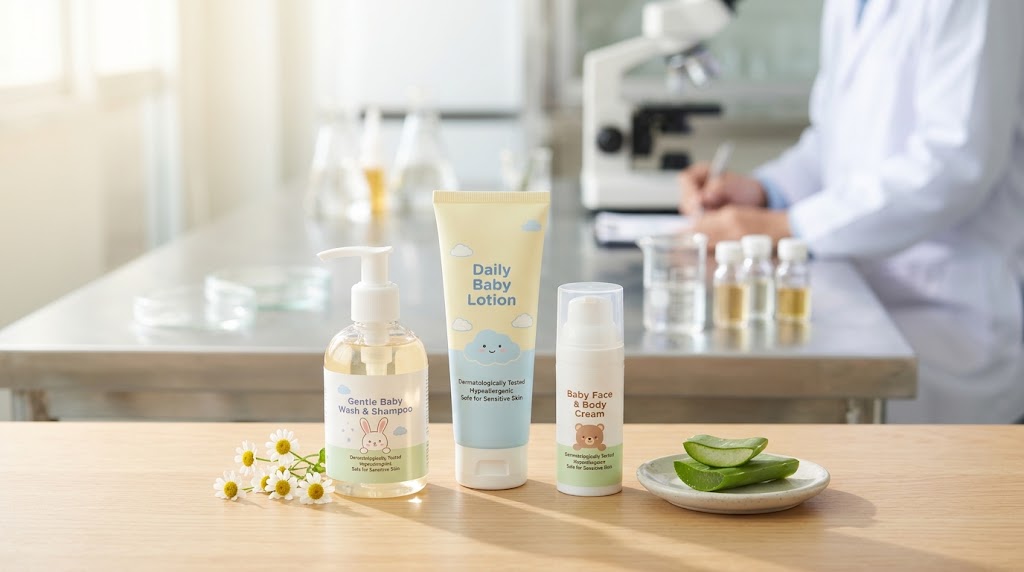
The baby and child personal care market is experiencing a massive surge. Numerous cosmetic manufacturers are racing to launch children’s skincare lines, ranging from body lotions and body washes to sunscreens.
However, formulating products for children is not simply a matter of reducing the active ingredient concentrations of adult products or adding sweet fragrances. From a medical and regulatory perspective, children’s skin is not a miniature version of adult skin.
The slightest formulation error can have fatal consequences, ranging from allergic contact dermatitis and systemic toxicity to mandatory product recalls by regulatory agencies (like BPOM/FDA). Therefore, children’s skincare demands uncompromisingly strict laboratory testing standards.
Table of Content:
- Physiological and Anatomical Differences in Children’s Skin
- Body Surface Area to Weight Ratio
- Vulnerability to Chemicals and Endocrine Disruptors
- Mandatory Laboratory Testing Parameters for Children’s Skincare
Physiological and Anatomical Differences in Children’s Skin
Structurally, the skin of babies and children especially infants has a significantly thinner stratum corneum (the outermost layer of the skin) compared to adults. The intercellular bonds in children’s skin are also looser. This means their skin barrier function is not yet fully developed.
Consequently, any chemicals applied via children’s skincare are absorbed much faster and deeper into the dermal layers.
Table of Content:
Why should children’s skincare be tested for heavy metal content?
Body Surface Area to Weight Ratio
The most critical factor often overlooked by formulators is the body surface area ratio. Children have a much larger body surface area relative to their body weight when compared to adults.
This means that if a product containing preservatives, synthetic fragrances, or heavy metal contaminants is applied all over a child’s body, the amount of chemicals entering the bloodstream (systemic absorption) will be massively higher, drastically increasing the risk of toxicity.
Vulnerability to Chemicals and Endocrine Disruptors
Ingredients that might be well-tolerated by adult skin, such as parabens, phthalates, harsh surfactants (SLS), and certain UV filters, are highly hazardous to children. Some of these ingredients act as endocrine disruptors.
Precise analytical testing is required to guarantee that the formulation is absolutely 0% free from prohibited substances and sits well below the safe threshold for restricted ingredients.
Mandatory Laboratory Testing Parameters for Children’s Skincare
To ensure products are safe for distribution, manufacturers must conduct rigorous high-level evaluations, including:
- Analytical Chemical Testing (e.g., HPLC/AAS): To verify the absolute absence of heavy metal contamination (Lead, Mercury, Arsenic) and dangerous active ingredients.
- Microbiological Testing: Because children’s skin is highly susceptible to infections, products must be 100% free from harmful pathogens such as Pseudomonas aeruginosa or Staphylococcus aureus.
- pH and Stability Testing: The product’s pH must be carefully balanced to mimic the natural acid mantle of a child’s skin (around pH 5.5) to avoid barrier degradation.
Consult Your Children’s Skincare Testing at IML Testing and Research Today!
Developing children’s skincare without rigorous analytical and microbiological testing is a ticking time bomb for your business. Mass skin irritation incidents will not only trigger devastating lawsuits but also result in the permanent revocation of your BPOM distribution licenses.
Stop taking fatal risks with your formulation’s safety. Schedule a cosmetic testing consultation with the experts at IML Testing and Research. We provide the highest precision in microbiological, heavy metal, and active ingredient analytical testing to ensure your baby and child products are 100% safe, scientifically validated, and ready to dominate the market.
Author & Editor: Lina
References
Wasitaatmadja, S. M. (1997). Penuntun Ilmu Kosmetik Medik. Jakarta: Penerbit Universitas Indonesia (UI-Press). (Referensi dasar anatomi dan fisiologi kulit serta penyerapan kosmetik pada rentang usia yang berbeda).
Tranggono, R. I., & Latifah, F. (2007). Buku Pegangan Ilmu Pengetahuan Kosmetik. Jakarta: PT Gramedia Pustaka Utama. (Membahas standar formulasi bahan kosmetik, bahan aktif, dan pH yang aman untuk skin barrier).
Badan Pengawas Obat dan Makanan (BPOM) RI. (2020). Peraturan Badan Pengawas Obat dan Makanan Nomor 23 Tahun 2019 tentang Persyaratan Teknis Bahan Kosmetika. Jakarta: BPOM RI. (Dokumen regulasi resmi terkait ambang batas bahan kimia, pengawet, dan cemaran mikroba pada kosmetik anak).
Boediardja, S. A. (2015). Kelainan Kulit pada Bayi dan Anak. Majalah Kedokteran Indonesia / Jurnal Dermatologi Anak. (Membahas tingginya tingkat absorpsi sistemik pada kulit bayi dan risiko dermatitis kontak akibat bahan kimia sintetis).