Cosmetic Laboratory Testing: Why Is It Important Amidst Findings of 2.1 Million Non-Compliant Products?

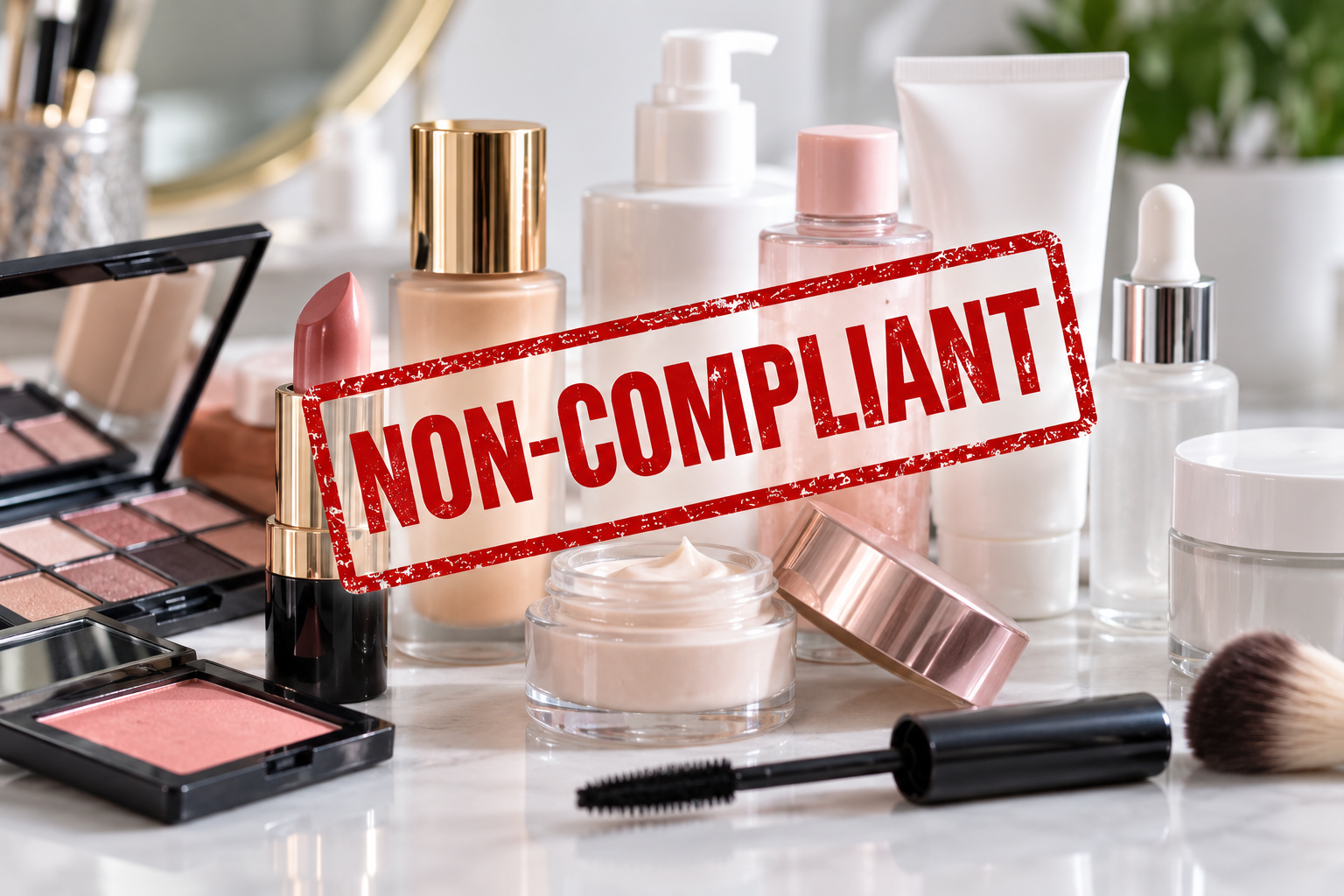
The cosmetics industry continues to grow as demand increases for skincare, makeup, and personal care products. However, market growth must be accompanied by effective quality control, safety assessments, and compliance with applicable regulations.
The discovery of more than 2.1 million non-compliant cosmetic product units highlights the importance of ensuring that products meet the necessary requirements before reaching consumers. Nevertheless, non-compliant cosmetics are not necessarily cosmetics containing hazardous ingredients.
Non-compliance may involve marketing authorization, import documentation, labeling, or product composition. The type of violation must be identified before conclusions are drawn about health risks. This is where cosmetic laboratory testing plays an important role. Laboratory analysis provides objective data on product composition, quality, safety-related characteristics, and performance before and during marketing.
Table of Content:
- BPOM Finds More Than 2.1 Million Non-Compliant Cosmetic Product Units
- Why Is Cosmetic Laboratory Testing Important?
- Types of Laboratory Tests for Cosmetic Products
- Are Laboratory Test Results Sufficient to Market Cosmetic Products?
BPOM Finds More Than 2.1 Million Non-Compliant Cosmetic Product Units
According to an announcement by Indonesia's National Agency of Drug and Food Control (BPOM) on July 13, 2026, an intensified surveillance operation conducted from May 11 to 22, 2026, identified 2,127,765 units of non-compliant cosmetic products, covering 2,205 product items at the inspected distribution facilities. The estimated economic value of the findings reached IDR 35.8 billion.
Of the 190 facilities inspected, 128 were found to be non-compliant. BPOM classified the product items into several categories:
| Category of non-compliance | Percentage of identified items |
|---|---|
| Illegal cosmetics or products without marketing authorization | 86.83% |
| Imported cosmetics without the required import documentation | 12.58% |
| Cosmetics containing hazardous or prohibited ingredients | 0.32% |
| Products used outside the regulatory definition of cosmetics | 0.27% |
These percentages refer to the identified product items, not all cosmetics circulating in Indonesia. They also do not mean that all 2.1 million product units were confirmed to contain hazardous substances. BPOM also identified 9,042 online links associated with regulatory violations.
These findings demonstrate that cosmetic surveillance covers both physical distribution channels and digital marketplaces. For manufacturers, they emphasize two distinct responsibilities: ensuring that products meet regulatory requirements and obtaining reliable evidence of their quality and safety through cosmetic laboratory testing.
Why Is Cosmetic Laboratory Testing Important?
Cosmetic laboratory testing provides information that cannot always be obtained through visual inspection or supplier documentation. A cosmetic product may have an attractive color, normal fragrance, and consistent texture while still containing substances that do not meet applicable requirements.
Conversely, satisfactory chemical test results alone do not establish complete regulatory compliance. The following are seven reasons why cosmetic laboratory testing is important.
1. Identifying hazardous and prohibited ingredients
One of the main purposes of laboratory analysis is to identify substances that are prohibited or subject to restrictions in cosmetic products. During its second-quarter surveillance in 2026, BPOM identified 14 cosmetic products containing hazardous or prohibited ingredients, including mercury, retinoic acid, hydroquinone, clobetasol propionate, mometasone furoate, and Red K10 dye.
The products underwent BPOM laboratory testing and failed to meet the applicable safety requirements. Through cosmetic laboratory testing using appropriate analytical methods, laboratories can help identify target compounds and determine their concentrations when validated quantitative methods are available.
This provides more objective evidence than relying solely on a product's appearance.
2. Verifying ingredient concentrations and formulation consistency
Every cosmetic formulation is designed to achieve specific product characteristics. However, variations in raw material quality, weighing errors, or manufacturing conditions may cause the final composition to differ from the intended specifications, making cosmetic laboratory testing essential for verifying product consistency and quality.
Cosmetic laboratory testing can help evaluate active ingredient concentrations and other relevant chemical parameters. For example, alpha arbutin or retinol content may be analyzed using appropriate methods, depending on the product formulation and testing objectives.
The resulting data can support formulation verification and quality control decisions.
3. Evaluating microbial contamination
Certain cosmetic formulations contain water and other components that may allow microorganisms to survive or grow when manufacturing and preservation systems are not adequately controlled. Cosmetic laboratory testing helps evaluate microbial contamination that may originate from raw materials, production water, equipment, the manufacturing environment, or product handling.
As part of cosmetic laboratory testing, microbiological testing helps assess the microbiological quality of finished products. Meanwhile, a Preservative Efficacy Test, also known as a Challenge Test, evaluates the ability of a preservative system to control specified microorganisms under defined test conditions.
These tests serve different purposes. A satisfactory microbiological result at one point in time does not automatically demonstrate that the preservative system will remain effective throughout product use.
4. Assessing product stability
Cosmetics may undergo physical or chemical changes during storage due to temperature, light, oxygen, and interactions between ingredients. Such changes may affect color, odor, texture, pH, or active ingredient concentrations, highlighting the importance of cosmetic laboratory testing in evaluating product stability.
As part of cosmetic laboratory testing, stability testing helps manufacturers monitor product characteristics under specified storage conditions. The results can support decisions regarding formulation development, packaging selection, and appropriate storage conditions.
5. Supporting skin safety evaluation
Cosmetic products are applied to different parts of the body, including the face, lips, hair, and skin. Therefore, cosmetic laboratory testing is important for evaluating potential adverse effects based on ingredient composition, concentrations, application areas, and expected exposure.
Relevant toxicity tests may provide information about specific hazards, such as skin irritation potential. However, a single test cannot establish every aspect of product safety. A comprehensive safety assessment must consider the overall formulation and relevant exposure information.
6. Providing evidence for product claims
Claims such as SPF 30, SPF 50, or specific protective performance require evidence obtained through appropriate testing methods. For example, the presence of UV filters in a formulation does not automatically establish the SPF value of the finished sunscreen.
Through Efficacy Testing, manufacturers can obtain performance data relevant to the claims being evaluated. This helps ensure that marketing claims are supported by measurable results rather than assumptions based solely on formulation.
7. Maintaining batch-to-batch consistency
Even products manufactured using the same formulation may vary due to differences in raw materials, mixing processes, temperatures, or storage conditions. Quality control should therefore be continuous rather than limited to the initial formulation development stage.
Manufacturers can establish testing parameters and frequencies based on product specifications and risk assessments. By comparing results across batches, companies can identify deviations earlier and take corrective action before distribution.
Types of Laboratory Tests for Cosmetic Products
The appropriate tests depend on the product's characteristics and the objectives of the evaluation.
| Type of test | Purpose |
|---|---|
| Chemical compound analysis | Identifies or quantifies active ingredients, specific substances, and contaminants. |
| Microbiological testing | Evaluates the microbiological quality of the product. |
| Preservative efficacy testing | Assesses the ability of the preservative system to control microorganisms. |
| Stability testing | Monitors changes in product characteristics during storage. |
| Toxicity testing | Evaluates potential adverse effects according to selected methods and endpoints. |
| Efficacy testing | Measures product performance to support specific claims, such as SPF protection. |
Not every cosmetic product requires all these tests. Manufacturers should consider the formulation, product type, intended use, claims, and applicable regulatory requirements. The availability of specific parameters and testing methods should be confirmed with the laboratory.
Are Laboratory Test Results Sufficient to Market Cosmetic Products?
Not necessarily. Laboratory testing is one component of regulatory compliance, not a substitute for the entire compliance process.
Manufacturers must also ensure that their products meet applicable requirements concerning product notification, labeling, documentation, and good manufacturing practices. BPOM issued Regulation No. 8 of 2026 concerning Good Cosmetic Manufacturing Practice (CPKB) certification, replacing the previous certification provisions.
This regulatory development reinforces the importance of controlled manufacturing systems alongside finished-product testing. A comprehensive quality management approach should therefore include raw material evaluation, manufacturing process controls, finished-product testing, documentation, and post-market monitoring.
Conclusion
The discovery of more than 2.1 million non-compliant cosmetic product units highlights the importance of meeting regulatory requirements. However, these findings must be interpreted accurately because most of the reported violations concerned product legality rather than confirmed hazardous ingredients.
Cosmetic laboratory testing helps manufacturers obtain data on product composition, quality, stability, safety-related characteristics, and performance according to the selected testing objectives. When combined with good manufacturing practices and regulatory compliance, laboratory testing provides a stronger foundation for maintaining cosmetic product quality before and during marketing.
Verify Cosmetic Quality and Safety Through Laboratory Testing
Don't rely solely on formulations, product appearance, or supplier documentation. Verify your cosmetic product's quality through appropriate laboratory testing!
Through Chemical Compound Testing, Toxicity Testing, and Efficacy Testing, IML Testing & Research can help manufacturers obtain data to support ingredient analysis, safety evaluation, and product performance assessments.
Contact IML Testing & Research today and discuss your cosmetic laboratory testing requirements with our team!
Author & Editor: Lina
References
National Agency of Drug and Food Control (BPOM). (2026, July 13). BPOM Finds More Than 2.1 Million Non-Compliant Cosmetic Products and Urges Consumers to Be More Careful. BPOM official publication .
National Agency of Drug and Food Control (BPOM). (2026). BPOM Identifies 14 Cosmetics Containing Hazardous and Prohibited Ingredients in the Second Quarter of 2026. BPOM publication .
Barel, A. O., Paye, M., & Maibach, H. I. (Eds.). (2014). Handbook of Cosmetic Science and Technology (4th ed.). CRC Press.
Salvador, A., & Chisvert, A. (Eds.). (2007). Analysis of Cosmetic Products. Elsevier.
Geis, P. A. (Ed.). (2006). Cosmetic Microbiology: A Practical Approach (2nd ed.). CRC Press.
Lundov, M. D., Moesby, L., Zachariae, C., & Johansen, J. D. (2009). Contamination versus preservation of cosmetics: A review on legislation, usage, infections, and contact allergy. Contact Dermatitis, 60(2), 70–78. DOI .
Draelos, Z. D. (Ed.). (2022). Cosmetic Dermatology: Products and Procedures (3rd ed.). Wiley-Blackwell.