Eco Friendly Packaging Is Not Necessarily Food-Safe: What Should Be Tested?

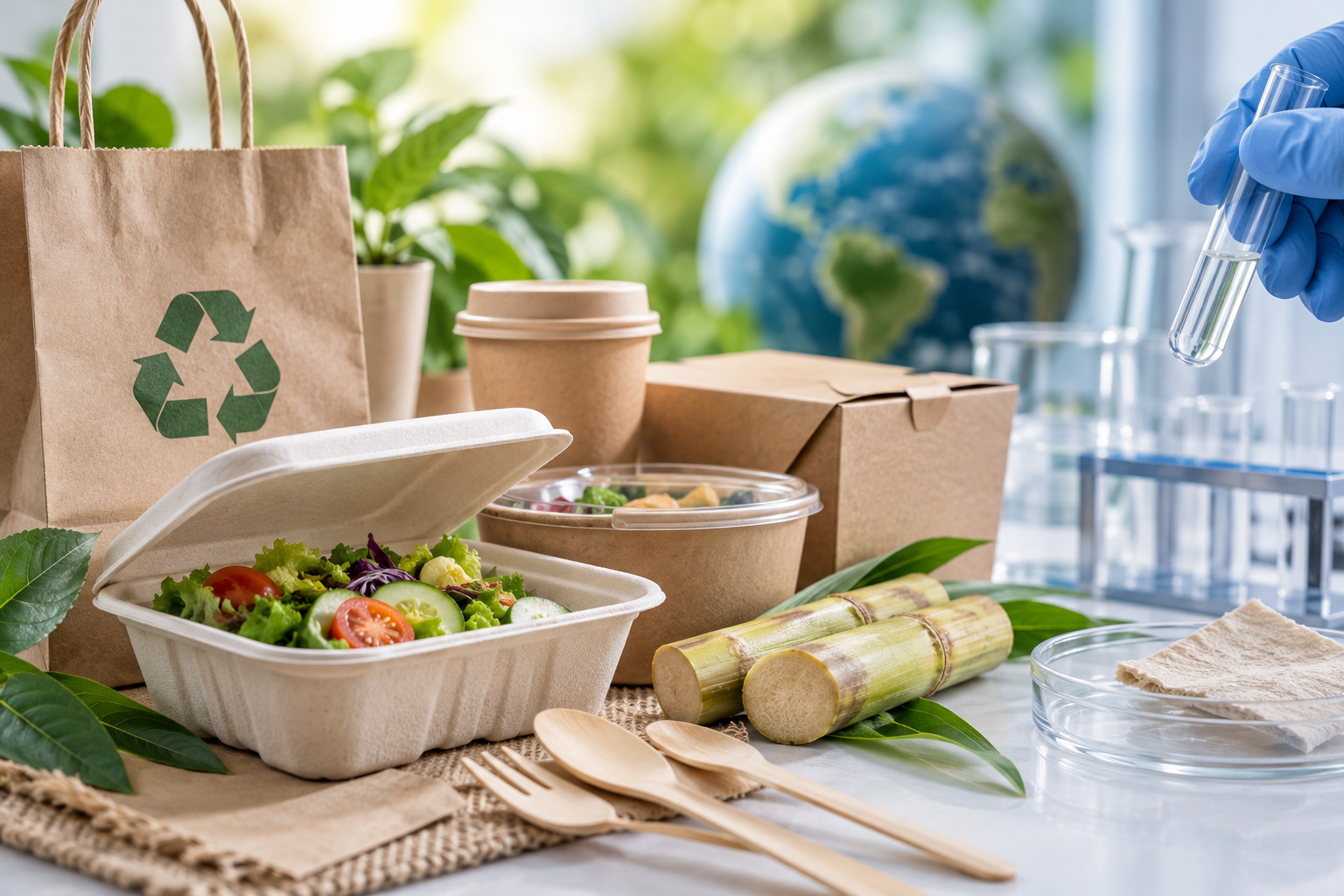
Eco friendly packaging is increasingly used in the food and beverage industry to help reduce environmental impacts. Recycled paper, bioplastics, sugarcane fiber, and plant-based materials are among the alternatives being explored.
However, eco-friendly packaging does not automatically guarantee food-contact safety. Its safety depends on several factors, including raw materials, additives, manufacturing processes, potential chemical migration, and intended conditions of use.
Laboratory testing therefore plays an important role in evaluating whether packaging materials are suitable for contact with food.
Table of Content:
- What Is Eco-Friendly Packaging?
- Why Is Eco-Friendly Packaging Not Always Food-Safe?
- 5 Important Tests for Evaluating Food Packaging Safety
- How Should Manufacturers Select the Appropriate Tests?
What Is Eco-Friendly Packaging?
Eco friendly packaging generally refers to packaging designed to reduce environmental impacts through approaches such as material reduction, recycled content, recyclability, compostability, or the use of renewable resources. Examples include recycled paper and cardboard, sugarcane bagasse containers, starch-based packaging, polylactic acid (PLA), and reusable food containers.
However, environmental claims and food-contact safety claims address different characteristics. Eco friendly packaging labeled biodegradable, compostable, or recyclable is not necessarily suitable for direct food contact without an appropriate safety evaluation.
Read Also:
BPA, Phthalates, Heavy Metals: Is Your Product Packaging Actually Safe?
Why Is Eco Friendly Packaging Not Always Food-Safe?
1. Chemical substances may migrate into food
Recycling can reduce the demand for virgin materials. However, recycled materials used in eco friendly packaging may contain substances introduced during previous use, collection, printing, or processing.
Muncke (2009) discusses chemical exposure from food-contact materials and highlights the importance of evaluating substances that may migrate into food. Migration depends on the properties of the material and food, contact temperature, exposure duration, and intended use.
For example, packaging intended for hot food may require different testing conditions from eco friendly packaging designed for dry food at room temperature.
2. Recycled materials may contain contaminants
Recycling can reduce the demand for virgin materials. However, recycled materials used in eco friendly packaging may contain contaminants introduced during previous use, collection, printing, or processing.
Recycled paper and cardboard used in eco friendly packaging, for instance, may contain residues associated with printing inks, mineral oils, and other chemicals. Pivnenko and colleagues (2016) examined chemicals in paper and cardboard and discussed their implications for recycling.
Consequently, manufacturers should evaluate raw material quality and potential contaminants when developing recycled food packaging.
3. Bioplastics may still contain additives
Bioplastics used in eco friendly packaging are not a single, chemically uniform material. PLA, starch-based materials, and polymer blends may contain plasticizers, fillers, colorants, or processing additives.
These components can influence packaging performance and its chemical characteristics. Therefore, testing should consider the finished formulation rather than relying exclusively on the renewable origin of its primary ingredients.
4. Intended use affects packaging safety
Packaging may come into contact with fatty, acidic, aqueous, or hot foods. Each food type can interact differently with packaging materials.
Heating, extended storage, and repeated use may also influence migration and material performance. A container suitable for dry food at room temperature should not automatically be considered suitable for microwave heating or prolonged contact with hot, fatty foods.
5 Important Tests for Evaluating Food Packaging Safety
1. Overall Migration Testing
Overall migration testing evaluates the total quantity of substances transferred from a packaging material into a food simulant under specified conditions. The results can help determine whether a material meets applicable overall migration requirements, where such limits apply.
2. Specific Migration Testing
Specific migration testing measures the transfer of individual chemical substances. Testing parameters are selected according to the material composition, additives, potential contaminants, and applicable requirements.
Relevant substances may include certain residual monomers, plasticizers, or other compounds subject to specific migration limits.
3. Heavy Metal Analysis
Heavy metals may originate from raw materials, pigments, or manufacturing contamination. Laboratory analysis can determine the presence and concentration of relevant elements, such as lead or cadmium, according to the material and testing objectives.
However, measuring total metal content does not necessarily establish how much migrates into food. Migration or release testing may be required separately.
4. Chemical Contaminant Analysis
Some packaging materials require targeted analysis for chemicals associated with inks, adhesives, coatings, recycled feedstocks, or manufacturing processes. Depending on the material, relevant parameters may include mineral oils, residual solvents, or other identified contaminants.
Analytical techniques such as GC-MS and LC-MS may be considered according to the target compounds and validated methods.
5. Microbiological Testing and Intended-Use Evaluation
Microbiological testing may be relevant for packaging that could become contaminated during manufacturing, handling, or storage. Physical performance testing can also assess resistance to heat, moisture, or grease, depending on the intended application.
However, microbiological and physical tests do not replace chemical migration testing.
How Should Manufacturers Select the Appropriate Tests?
Testing requirements vary according to the packaging material and its intended application. Manufacturers should consider material composition, recycled content, food type, contact temperature, storage duration, reuse conditions, and applicable food-contact requirements.
For example, recycled paper packaging may require particular attention to contaminants associated with its previous life cycle. Bioplastic packaging, meanwhile, may require evaluation of relevant additives, residual monomers, and potential migrants.
For migration testing, food simulants and test conditions should appropriately represent the intended food-contact application.
Conclusion
Eco-friendly packaging can contribute to reducing environmental impacts, but environmental benefits alone do not establish food-contact safety. Chemical migration, recycled-material contaminants, additives, and intended conditions of use should all be considered when selecting appropriate testing methods.
Laboratory data can help manufacturers make more informed decisions about material selection, quality control, and packaging suitability.
Verify Eco-Friendly Food Packaging Safety Through Laboratory Testing
Don't rely solely on environmental claims. Evaluate chemical composition and potential migration from packaging materials to support the safety of your food products!
Through Chemical Compound Testing, manufacturers can obtain relevant analytical data to support material evaluation and packaging quality control. Contact IML Testing & Research today and discuss your food packaging testing requirements with our team!
Author & Editor: Lina
References
Muncke, J. (2009). Exposure to endocrine disrupting compounds via the food chain: Is packaging a relevant source? Science of the Total Environment, 407(16), 4549–4559. DOI .
Geueke, B., Groh, K., & Muncke, J. (2018). Food packaging in the circular economy: Overview of chemical safety aspects for commonly used materials. Journal of Cleaner Production, 193, 491–505. DOI .
Groh, K. J., Backhaus, T., Carney-Almroth, B., et al. (2019). Overview of known plastic packaging-associated chemicals and their hazards. Science of the Total Environment, 651, 3253–3268. DOI .
Pivnenko, K., Olsson, M. E., Götze, R., Eriksson, E., & Astrup, T. F. (2016). Quantification of chemical contaminants in the paper and board fractions of municipal solid waste. Waste Management, 51, 43–54.
Robertson, G. L. (2013). Food Packaging: Principles and Practice (3rd ed.). CRC Press.
Piringer, O. G., & Baner, A. L. (Eds.). (2008). Plastic Packaging: Interactions with Food and Pharmaceuticals (2nd ed.). Wiley-VCH.
Marsh, K., & Bugusu, B. (2007). Food packaging—Roles, materials, and environmental issues. Journal of Food Science, 72(3), R39–R55. DOI .