Strategies for Antimicrobial Efficacy Testing on Deodorant Spray Products Against Staphylococcus and Corynebacterium Bacteria

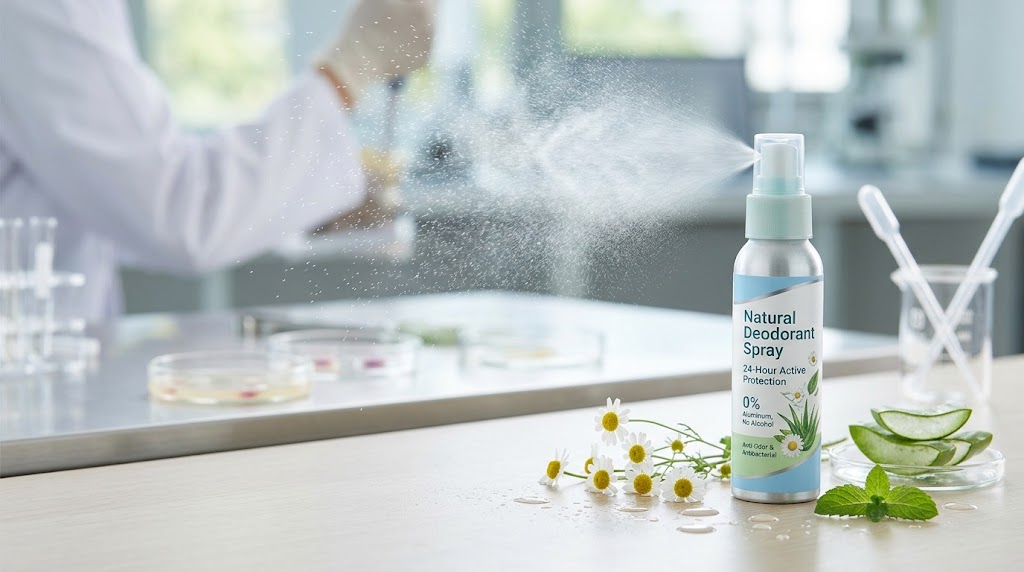
Today’s personal care industry demands much more than just marketing promises. Consumers are increasingly educated; they no longer seek products that merely smell good, but rather functional solutions that tackle the root cause of body odor (bromhidrosis).
In this context, a deodorant spray formulation must be able to prove its effectiveness clinically and microbiologically. Many cosmetic manufacturers fall into the trap of assuming that masking body odor with fragrance is sufficient.
In reality, human sweat is fundamentally odorless. Body odor only develops when the natural microflora residing in the axillary (armpit) region break down apocrine sweat components into pungent volatile fatty acids and thioalcohols.
Read Also:
- The Culprits of Body Odor: Staphylococcus and Corynebacterium
- The Importance of Antimicrobial Efficacy Testing on Deodorant Spray
The Culprits of Body Odor: Staphylococcus and Corynebacterium
The two primary bacterial genera that dominate the underarm microbiome and serve as the main targets for any effective deodorant spray formulation are:
- Staphylococcus (specifically S. epidermidis and S. hominis): These bacteria metabolize sweat into isovaleric acid, producing a sharp, sour scent.
- Corynebacterium (specifically C. xerosis and C. striatum): These are the major producers of enzymes that convert apocrine secretions into thioalcohols, generating the highly pungent odor universally recognized as chronic body odor.
Read Also:
Deodorant vs Antiperspirant: Which Is More Effective in Combating Underarm Odor?
The Importance of Antimicrobial Efficacy Testing on Deodorant Spray
To legally and ethically claim that your deodorant spray “Kills 99.9% of Odor-Causing Bacteria” or “Provides 48-Hour Protection,” regulatory bodies (like BPOM and the FDA) require you to possess substantive supporting data from an independent laboratory.
This testing typically utilizes methods such as the Time-Kill Assay or Minimum Inhibitory Concentration (MIC). The analytical laboratory will expose your product sample to standardized pure cultures of Staphylococcus and Corynebacterium.
Following a specific contact time (e.g., 30 seconds, 1 minute, or 1 hour), the analysts calculate the bacterial death rate (log reduction). It is solely through this rigorous microbiological testing that the antibacterial claims on your packaging are legally validated.
Possessing precise quantitative data from this log reduction result is not merely an administrative formality to meet regulatory standards; it is a highly valuable marketing asset. In today’s fiercely competitive personal care market, modern consumers are far more likely to trust brands that provide definitive scientific proof—such as the claim “Laboratory tested to kill 99.9% of odor-causing bacteria”—rather than just empty promises of long-lasting fragrances. By holding a credible Certificate of Analysis, your deodorant spray product not only avoids the regulatory risks of overclaiming but also gains a superior, transparent, and trustworthy Unique Selling Proposition (USP) to dominate the market.
Do Not Let Your Anti-Bacterial Claims Be Labeled as “Overclaims” by Regulators!
Distributing a deodorant spray with bacteria-killing claims without substantive laboratory evidence is a regulatory violation that risks mass product recalls and a total loss of consumer trust.
Prove the efficacy of your formulation right now. Schedule your Antimicrobial Efficacy Testing at IML Testing and Research. Our microbiological laboratories are equipped with high-precision instruments to test your product’s antibacterial activity against Staphylococcus, Corynebacterium, and other pathogens. We provide regulatory-recognized Certificates of Analysis to solidify your marketing claims.
Author & Editor: Lina
Daftar Pustaka
Brooks, G. F., Carroll, K. C., Butel, J. S., & Morse, S. A. (2014). Mikrobiologi Kedokteran Jawetz, Melnick, & Adelberg (Edisi ke-25). Jakarta: EGC. (Referensi utama mengenai klasifikasi, karakteristik, dan metabolisme bakteri patogen dan flora normal kulit seperti Staphylococcus dan Corynebacterium).
Tranggono, R. I., & Latifah, F. (2007). Buku Pegangan Ilmu Pengetahuan Kosmetik. Jakarta: PT Gramedia Pustaka Utama. (Membahas mekanisme kerja antiperspiran dan deodoran, serta standar perumusan kosmetik yang aman dan efektif).
Radji, M. (2011). Buku Ajar Mikrobiologi: Panduan Mahasiswa Farmasi dan Kedokteran. Jakarta: EGC. (Memberikan rujukan spesifik mengenai metode uji sensitivitas antimikroba, penentuan KHM/MIC, dan Time-Kill Assay pada produk farmasi dan sediaan topikal).
Peraturan Badan Pengawas Obat dan Makanan (BPOM) RI Nomor 3 Tahun 2022. Persyaratan Teknis Klaim Kosmetika. Jakarta: BPOM RI. (Regulasi resmi yang mewajibkan penyertaan data uji laboratorium untuk setiap klaim antibakteri, antimikroba, atau penahan bau pada label kosmetik).