Over-Facial Exfoliation: Its Impact on Skin Health and How to Choose the Right Products

Human skin naturally undergoes a regeneration process to maintain its protective function against environmental factors. Various studies indicate that epidermal cell turnover in healthy skin takes approximately 40–56 days, although this duration may vary depending on age, skin condition, and external influences. In skincare routines, facial exfoliation is often used to help remove dead skin cells, but it should be done properly to avoid disrupting the skin’s natural regeneration process.
During this process, new skin cells are produced in the basal layer of the epidermis and gradually migrate toward the surface, where they eventually undergo keratinization and are shed as dead skin cells. Dead skin cells, also known as corneocytes, are mature skin cells that have lost their nuclei and cellular organelles as part of the skin’s natural maturation process.
While the presence of dead skin cells is entirely normal, problems can arise when they accumulate excessively on the skin’s surface. An excessive buildup of dead skin cells can interfere with the natural shedding process, causing the skin to feel rough and appear dull.
In addition to reducing the skin’s ability to reflect light evenly, accumulated dead skin cells can combine with sebum and clog pores. This condition is one of the primary factors contributing to the formation of both open and closed comedones.
In some individuals, persistent pore blockage may also encourage the proliferation of acne-causing bacteria, leading to inflammation and breakouts. Therefore, managing dead skin cell accumulation is an important aspect of maintaining healthy skin
Table of Charts:
- Facial Exfoliation as a Solution for Dead Skin Cell Buildup
- Understanding Chemical Exfoliation and How It Works
- The Risks of Over-Exfoliation
Facial Exfoliation as a Solution for Dead Skin Cell Buildup
To help address the accumulation of dead skin cells, the cosmetic industry offers a wide range of facial exfoliating and peeling products. Facial cleansers such as face wash, micellar water, and cleansing oils are primarily designed to remove dirt, excess oil, and makeup residue from the skin’s surface.
Although these products help maintain skin cleanliness, they are generally not sufficient to significantly accelerate the removal of dead skin cells that adhere strongly to the outermost layer of the epidermis. For this reason, facial exfoliation is often incorporated as an additional skincare step aimed at promoting desquamation, the natural shedding of dead skin cells.
When performed appropriately, facial exfoliation can leave the skin feeling smoother, looking brighter, and displaying a more refined texture. Facial exfoliation is generally divided into two categories: physical exfoliation and chemical exfoliation.
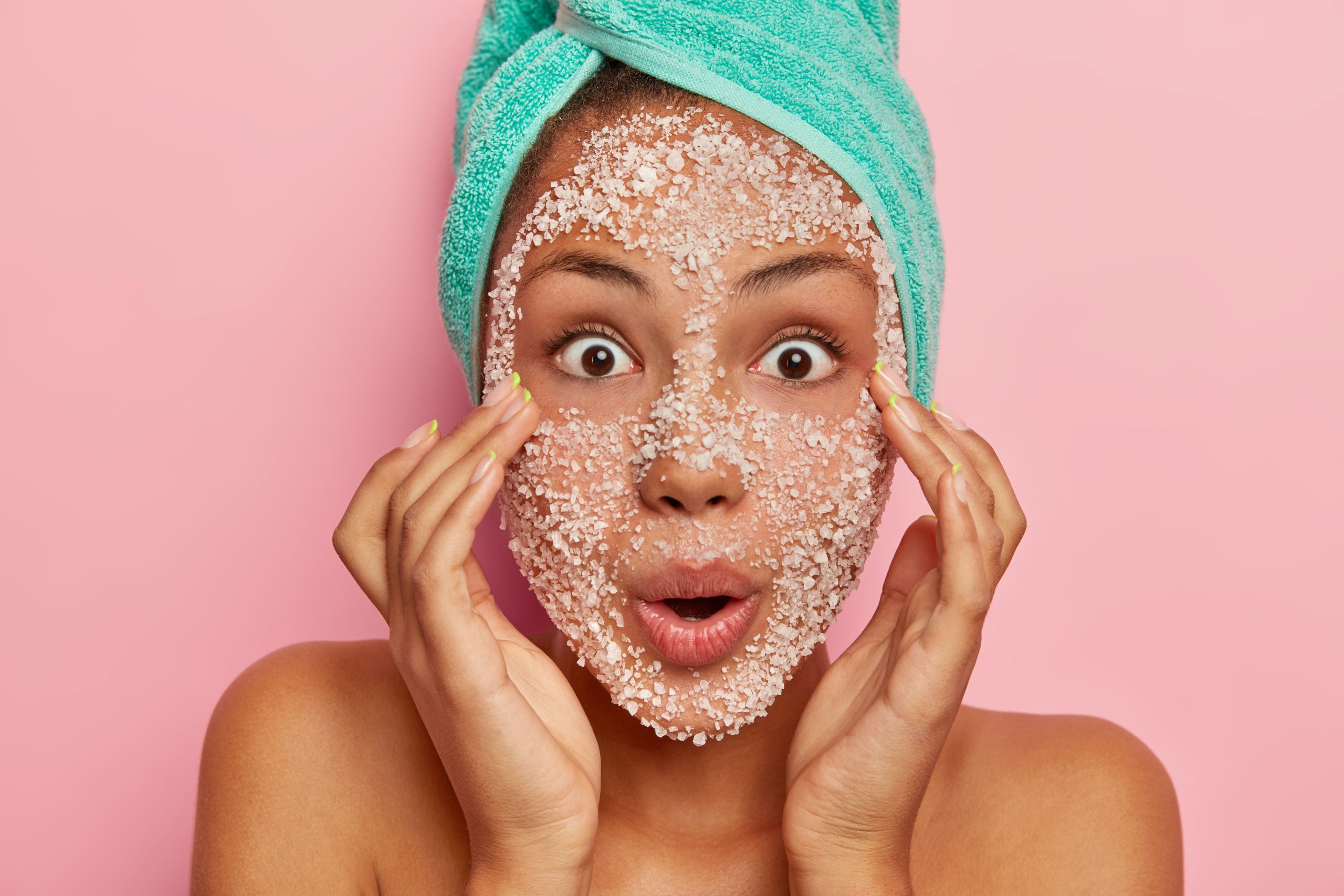
Physical exfoliation utilizes fine particles or scrubbing agents that work through mechanical friction to dislodge dead skin cells from the skin’s surface. This method often provides an immediate sensation of smoother skin; however, it may also trigger redness or irritation, particularly in individuals with sensitive skin.
The risk increases when excessive pressure is applied or when facial exfoliation is performed too frequently. For this reason, physical exfoliants are usually not recommended immediately after dermatological procedures or clinical treatments that temporarily increase skin sensitivity.
Read Also:
Physical vs Chemical Facial Exfoliation: Which Exfoliation is Good for Your Skin?
Understanding Chemical Exfoliation and How It Works
Chemical exfoliation relies on acidic compounds that loosen the bonds between dead skin cells, allowing them to be shed more easily. The most commonly used categories are Alpha Hydroxy Acids (AHAs), Beta Hydroxy Acids (BHAs), and Polyhydroxy Acids (PHAs).
AHAs, such as glycolic acid and lactic acid, are water-soluble acids that primarily work on the skin’s surface to improve texture, reduce dullness, and promote a more even skin tone. BHA, most notably salicylic acid, is oil-soluble, enabling it to penetrate pores and help remove excess sebum and debris that contribute to comedone formation.
Meanwhile, PHAs such as gluconolactone and lactobionic acid possess larger molecular structures, resulting in slower penetration and making them a gentler option for sensitive skin. In many modern skincare formulations, AHAs, BHAs, and PHAs are combined to provide complementary benefits.
AHAs focus on improving the skin’s surface, BHAs target clogged pores, and PHAs offer milder exfoliation while helping to maintain skin hydration. During application, some chemical exfoliants may cause a temporary stinging or tingling sensation.
This reaction is generally associated with the product’s low pH and the activity of the acids on the outermost layer of the skin. High-strength peeling products are often designed as rinse-off treatments that should remain on the skin only for a short period to minimize the risk of irritation.
Rather than physically scraping away skin, these acids work by weakening the connections between corneocytes, allowing dead skin cells to detach more efficiently and leaving the skin feeling smoother. The effects of chemical exfoliation are not always immediately visible, even though the skin may feel softer after the first use.
Improvements in brightness, texture, and overall skin appearance typically require consistent use over several weeks, aligning with the skin’s natural renewal cycle. In many cases, noticeable results become more evident after one or more complete turnover cycles have occurred.
Therefore, facial exfoliation should be viewed as a gradual process rather than an instant solution that permanently transforms the skin after a single application.
The Risks of Over-Exfoliation
Although facial exfoliation offers numerous benefits, excessive facial exfoliation can negatively impact skin health. The skin already possesses a natural renewal mechanism, and exfoliation should serve only as a supportive measure to address concerns such as product buildup, environmental pollution, excess oil production, and stress-related skin changes.
When exfoliation is performed too frequently or with products that are too strong for the skin’s needs, the skin barrier may become compromised. Immature skin cells can be removed prematurely before completing their natural differentiation process.
As a result, the skin’s protective function weakens, increasing susceptibility to irritation, redness, discomfort, and moisture loss. Over-facial exfoliation can also create a cycle of damage that users may not immediately recognize.
Once the skin barrier becomes impaired, the skin often becomes more reactive to skincare products and environmental stressors. This heightened sensitivity is sometimes mistaken as a sign that additional facial exfoliation is needed, when in reality the skin requires barrier repair and recovery.
Over time, this pattern can cause the skin to appear thinner, become more prone to inflammation, and develop increased sensitivity. Consequently, both the type of exfoliant and the frequency of use should be carefully tailored to an individual’s skin condition.
Ensure Exfoliating Products Are Safe and Claim-Supported
IML Testing and Research can support cosmetic laboratory testing to help ensure the safety, quality, and claim support of exfoliating products before market release. Consult your cosmetic testing needs with the IML Testing and Research team.
Conclusion
Exfoliation is a valuable skincare practice that helps remove accumulated dead skin cells, improve skin texture, and promote a brighter complexion. Both physical and chemical exfoliation offer distinct mechanisms of action and are suitable for different skin needs.
However, these benefits can only be achieved when exfoliation is performed appropriately and in moderation. Excessive exfoliation may compromise the skin barrier and trigger a range of adverse effects that undermine overall skin health. Therefore, understanding one’s skin condition and selecting suitable exfoliating products are essential steps toward achieving healthy, balanced, and resilient skin.
Author: Delfia
Editor: Lina
References :
Iizuka H. (1994). Epidermal Turnover Time. Journal of Dermatological Science, 8(3), 215–217.
Halprin KM. (1972). Epidermal Turnover Time—A Re-examination. British Journal of Dermatology, 86(1), 14–19.
Fuchs E. (2009). Making an Epidermis. Nature Reviews Molecular Cell Biology, 10(8), 550–561.