Understanding Mycena chlorophos (Glow-in-the-Dark Fungus) through Microbiological Testing

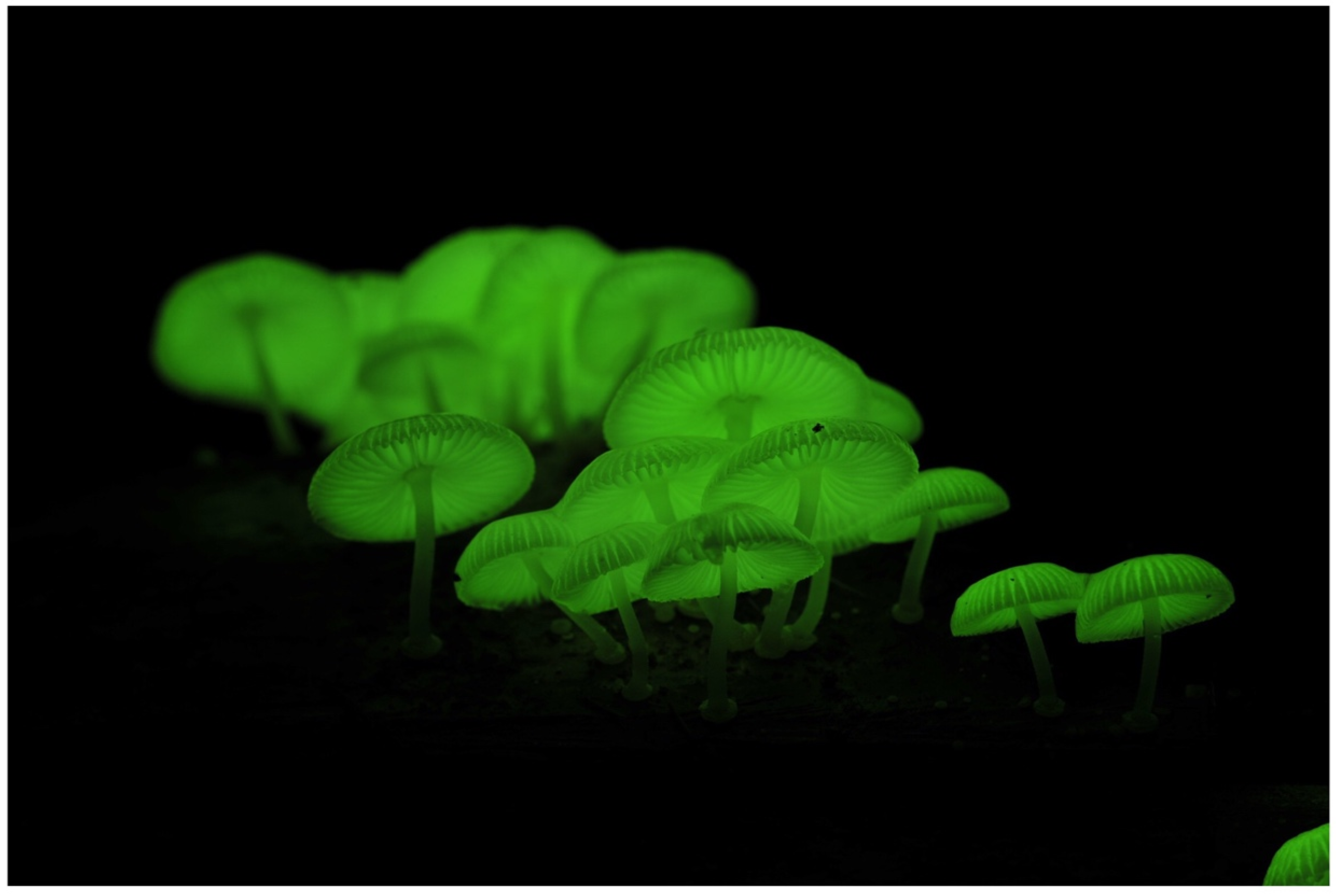
Bioluminescent organisms are living beings capable of producing their own light through chemical reactions within their bodies. This light is generated when a chemical compound called luciferin reacts with oxygen with the help of the enzyme luciferase. Bioluminescent organisms play an important role in life on Earth, serving functions such as attracting prey, defending against predators, enabling communication between individuals, and supporting reproduction through spore dispersal in fungi.
There are approximately 700 genera of bioluminescent organisms, including fungi, which account for 98 known species. Bioluminescent fungi belong mainly to the families Mycenaceae (the most dominant), Omphalotaceae, Pleurotaceae, and Physalacriaceae.
- Not All Fungi Glow in the Same Way
- A Closer Look at Mycena chlorophos
- Habitat and Distribution of Mycena chlorophos
- History and Mechanism of Bioluminescence
- Microbiological Testing to Reveal the Bioluminescence Process
Not All Fungi Glow in the Same Way
Each fungal species produces light at different intensities. In some fungi, only the mycelium emits light, while in others both the mycelium and the fruiting body are bioluminescent. There are also species in which only the fruiting body glows, while the mycelium does not. This article introduces one bioluminescent species from the Mycenaceae family, Mycena chlorophos.
A Closer Look at Mycena chlorophos
M. chlorophos is a fungal species first discovered in 1860 in parts of Asia, including India, Japan, Taiwan, and Indonesia, as well as in Australia and Brazil. Morphologically, this fungus has a pale grayish-brown cap that is slightly sticky, with a diameter of up to 30 mm, and a stalk height ranging from 6 to 30 mm. It emits a faint green light in dark environments. M. chlorophos grows in forests on dead wood such as twigs, branches, or decaying tree trunks. This species is also known to be cultivable under laboratory conditions for research purposes.
Habitat and Distribution of Mycena chlorophos
In Japan, this fungus is known as Konruri-kyuban-take, which translates to “deep blue suction-cup mushroom.” Its base displays a bright blue color (konruri) and a disc-like shape (kyuban). However, despite its resemblance to other species in the genus Mycena, DNA analysis reveals significant genetic differences. Generally, M. chlorophos grows in clusters in forests on dead wood, such as fallen twigs, branches, or tree bark. In Japan, particularly in the Hachijo and Bonin Islands, this fungus appears only during the rainy season, around June–July and September–October.
History and Mechanism of Bioluminescence
The phenomenon of bioluminescence has been known since ancient times. Bioluminescence is a chemical reaction within an organism that produces light without generating heat. In ancient Greek and Roman times, Aristotle was the first to observe glowing organisms in dead fish and worms. During the Middle Ages, reports of glowing seas and fireflies became more common.
In the 19th century, scientists Raphael Dubois and E. Newton Harvey began investigating the causes of light production in organisms. Dubois proposed that light is produced through a reaction between luciferin and the enzyme luciferase, which then reacts with oxygen to produce oxyluciferin and green light with a wavelength of approximately 520–530 nm.
The emitted light is the result of energy released when luciferin molecules are oxidized. Uniquely, fungal bioluminescence involves a recycling system in which luciferin is continuously synthesized and reused, allowing the light to glow continuously.
Bioluminescent fungi are a clear example of how nature operates through remarkable scientific processes. From small-scale chemical reactions to complex genetic systems, the light they produce is not merely a visual wonder but also a reminder that every living organism plays an important role in maintaining ecological balance. By continuing to study and preserve this biodiversity, we not only gain a deeper understanding of nature but also learn from it.
Microbiological Testing to Reveal the Bioluminescence Process
Behind the natural beauty of the light produced by Mycena chlorophos lies a highly complex and precise microbiological process. Biochemical reactions, enzyme activity, and genetic mechanisms that enable this fungus to emit light can only be thoroughly understood through a measured and scientific approach.
This is why research on microorganisms, including fungi, cannot be separated from accurate and reliable microbiological laboratory testing. Through microbiological laboratory testing, the characteristics of microorganisms can be identified, analyzed, and comprehensively understood, from enzyme activity and growth patterns to their potential applications.
Read more:
Flawless Disease Detection with Polymerase Chain Reaction (PCR) and Molecular Diagnostics!
To ensure accurate and accountable results, testing must be conducted in laboratories with proven competence and standardized methods. Make sure your microbiological research and testing are carried out using the right scientific approach through professional microbiological laboratory testing services.
Author: Safira
Editor: Sabilla Reza
References:
Arya, C. P., Ratheesh, S., & Pradeep, C. K. (2021). New record of luminescent Mycena chlorophos (Mycenaceae) from Western Ghats of India. Studies in Fungi, 6(1), 507–513. https://doi.org/10.5943/sif/6/1/40
Cortés-Pérez, A., Desjardin, D. E., & others. (2024). Evolution and diversity of bioluminescent fungi. Diversity, 16(539). https://doi.org/10.3390/d16050539.
iNaturalist. (n.d.). Mycena chlorophos. iNaturalist. Retrieved October 23, 2025, from https://www.inaturalist.org/taxa/155173-Mycena-chlorophos
Oba, Y., & Hosaka, K. (2023). The luminous fungi of Japan. Journal of Fungi, 9(615). https://doi.org/10.3390/jof9060615