Lipstick Color Inconsistent Between Batches? Here Are the Possible Causes

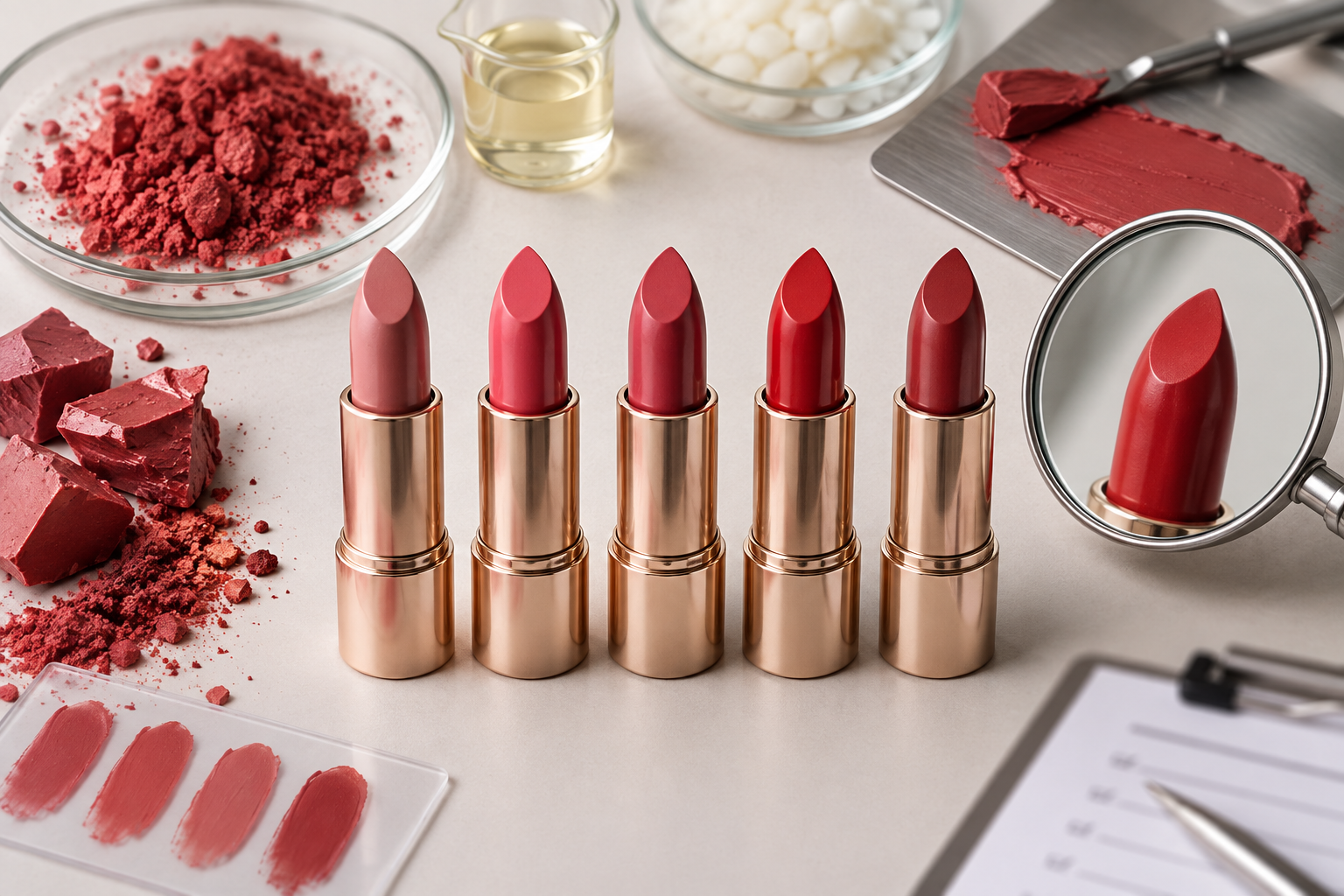
Consistency is an important aspect of decorative cosmetic manufacturing. Consumers expect the same lipstick color to provide a relatively consistent appearance each time they purchase it.
However, lipstick color may vary between production batches even when manufacturers use the same basic formulation. The difference may appear as a slightly darker, lighter, redder, or differently toned shade.
These variations do not necessarily originate from a single cause. Raw material characteristics, pigment dispersion, processing conditions, and product stability may all contribute. Understanding these factors can help manufacturers investigate batch-to-batch variations more systematically.
Table of Content:
- Variation in Pigment Characteristics
- Inconsistent Pigment Dispersion
- Differences in Formulation Composition
- Temperature and Manufacturing Conditions
- Colorant Stability
- Raw Material Quality and Consistency
- Product Storage Conditions
- Can Color Differences Always Be Detected Visually?
- Why Is Laboratory Analysis Important?
Variation in Pigment Characteristics
Pigments are among the primary components responsible for lipstick color. Decorative cosmetics may use organic and inorganic pigments in different combinations to produce a particular shade.
However, pigment characteristics may vary between raw material lots. Relevant parameters may include:
- particle size and distribution;
- purity;
- crystal characteristics;
- surface properties;
- color strength; and
- composition.
Pigments such as iron oxides and titanium dioxide have optical properties influenced by their physical and chemical characteristics. Because a lipstick color may contain several coloring materials, relatively small variations in one component can potentially influence the appearance of the final formulation.
Read Also:
Identify Unsafe Lipstick Colorants with Toxicity Tests on Your Lipstick Products!
Inconsistent Pigment Dispersion
Using the correct amount of pigment does not automatically guarantee consistent color. Pigments must be adequately dispersed throughout the lipstick matrix.
Agglomeration or non-uniform particle distribution may affect color intensity and appearance. Manufacturing parameters such as mixing, milling, homogenization, temperature, and processing time can influence dispersion quality.
Particle characteristics also influence how light interacts with the formulation. Therefore, changes in dispersion may alter the visual appearance of lipstick color even when nominal pigment concentrations remain similar.
For this reason, manufacturers should consider both pigment concentration and dispersion quality when investigating color variations.
Differences in Formulation Composition
Lipsticks color contain more than coloring agents. A formulation may include waxes, oils, emollients, film-forming materials, antioxidants, and other ingredients.
Small changes in the proportions or characteristics of these materials may affect product texture and application behavior. For example, differences in the oil-to-wax ratio may change how the lipstick forms a layer on the lips, potentially influencing the perceived intensity and appearance of the color.
Weighing errors, scale-up variations, and inconsistent manufacturing procedures may also contribute to batch-to-batch differences. Therefore, controlled manufacturing procedures are important for maintaining consistent lipstick color and overall product characteristics.
Temperature and Manufacturing Conditions
Temperature is an important processing parameter in lipstick manufacturing. Waxes and oil-based materials typically require controlled heating and mixing.
Variations in temperature or heating duration may affect the physical characteristics of the mixture. Temperature can also change viscosity, which may subsequently influence pigment distribution or settling behavior.
Cooling conditions after molding may further influence the physical structure, surface appearance, and texture of the finished lipstick. For these reasons, maintaining controlled processing parameters can help reduce unwanted batch-to-batch variation.
Colorant Stability
Some coloring materials may be affected by environmental conditions. Light, heat, oxygen, moisture, relevant pH conditions, and interactions with other formulation components may influence material stability.
Chemical changes in certain ingredients may eventually alter color intensity or appearance. Stability evaluation is therefore important not only for determining whether the initial lipstick color meets specifications but also for assessing whether those characteristics remain acceptable throughout the intended storage period.
A color change observed after storage may consequently indicate a stability-related issue rather than simply an initial mixing problem.
Raw Material Quality and Consistency
Cosmetic raw materials may originate from different production lots. Establishing and monitoring appropriate raw material specifications can therefore help manufacturers control final-product consistency.
For coloring materials, relevant specifications may include identity, purity, physical characteristics, and other parameters appropriate to the ingredient. In the United States, cosmetic color additives are subject to FDA requirements, and some color additives require batch certification before use.
Appropriate raw material controls can reduce the risk that variations in incoming materials lead to unexpected differences in lipstick color.
Product Storage Conditions
A lipstick that meets its initial color specification may still change during storage. Elevated temperature, light, oxygen exposure, and other environmental factors may accelerate changes in certain formulation components.
Oxidation of oil-based ingredients, for example, can affect product characteristics. Degradation of other materials may also result in changes to appearance, odor, or texture.
Packaging can help protect the formulation from external conditions, making formula-packaging compatibility another relevant consideration during product development. Differences in storage or distribution conditions should therefore be investigated when color variations are observed between products.
Can Color Differences Always Be Detected Visually?
Not necessarily, visual evaluation can identify obvious differences, but human color perception is influenced by lighting, background, viewing conditions, and individual observers. Instrumental color measurement can provide more objective information.
Color systems such as CIELAB describe color using L*, a*, and b* coordinates. Differences between samples can subsequently be evaluated using color-difference parameters such as ΔE. This approach allows manufacturers to compare batches numerically rather than relying entirely on subjective visual assessment.
However, the analytical method and acceptance criteria should be established according to the product characteristics and quality objectives.
Why Is Laboratory Analysis Important?
When lipstick color varies between batches, identifying the source of the variation requires a systematic investigation. Laboratory testing can evaluate selected parameters in raw materials and finished products.
Depending on the analytical objective, testing may include:
- material identification;
- concentration of specific compounds;
- raw material purity;
- impurities;
- component stability;
- physicochemical characteristics; and
- other formulation-related parameters.
These data can help determine whether a change is associated with chemical composition, degradation, raw material variation, or other factors.
Support Cosmetic Product Consistency Through Laboratory Testing
Noticing differences in lipstick color between production batches? Don't rely solely on visual inspection to identify the cause. Evaluate relevant formulation components and material characteristics through Chemical Compound Testing to obtain data that can support quality control, variation investigations, and product development.
Contact IML Testing & Research today and discuss your cosmetic product testing requirements with our team!
Author & Editor: Lina
References
U.S. Food and Drug Administration. Color Additives and Cosmetics: Fact Sheet. FDA.
U.S. Food and Drug Administration. Color Additives Permitted for Use in Cosmetics. FDA.
International Organization for Standardization. ISO/CIE 11664-4. Colorimetry — Part 4: CIE 1976 L*a*b* Colour Space.
International Organization for Standardization. ISO/CIE 11664-6. Colorimetry — Part 6: CIEDE2000 Colour-Difference Formula.
Barel, A. O., Paye, M., & Maibach, H. I. (Eds.). Handbook of Cosmetic Science and Technology. CRC Press.
Poucher, W. A. Poucher's Perfumes, Cosmetics and Soaps. Springer.
Schlossman, M. L. (Ed.). The Chemistry and Manufacture of Cosmetics. Allured Publishing.