7 Fertilizer Quality Testing Parameters for NPK Fertilizer Before Market Release

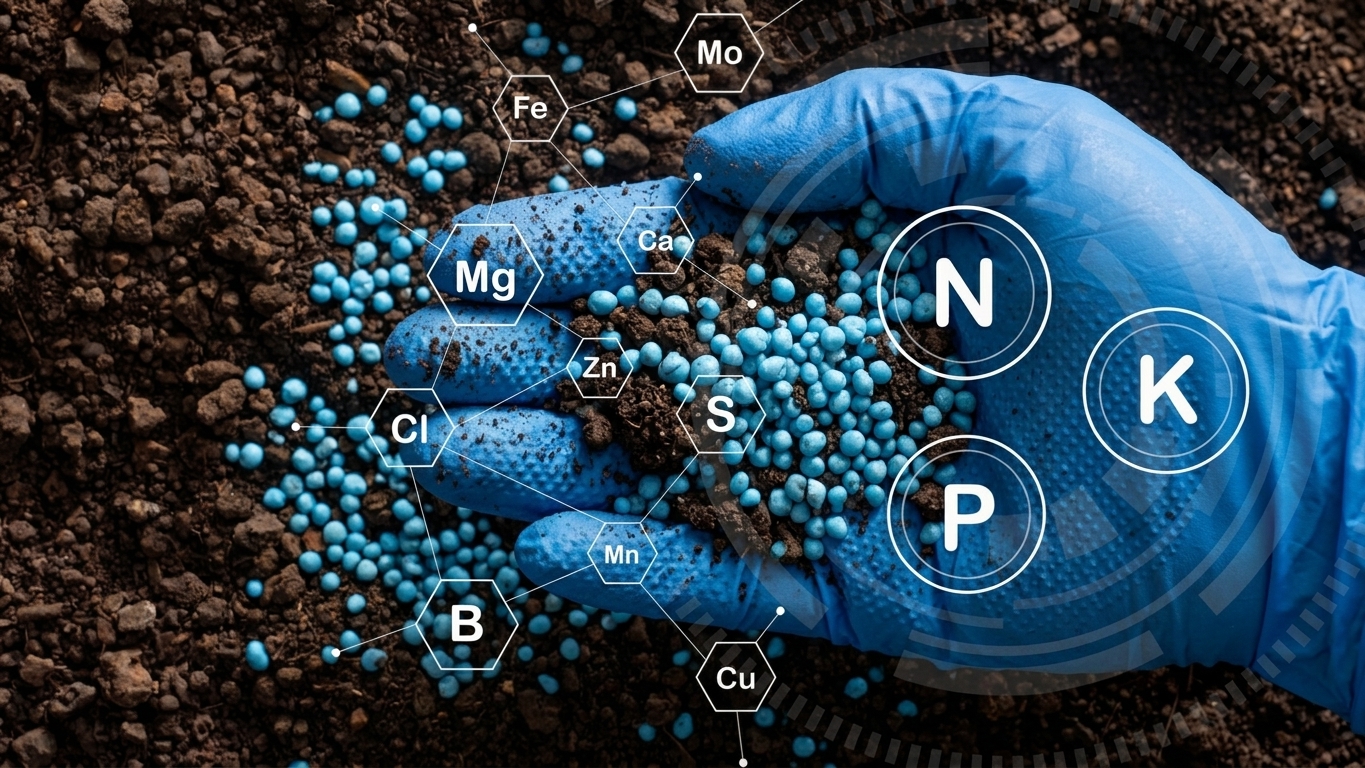
NPK fertilizer supplies three major plant nutrients—nitrogen (N), phosphorus (P), and potassium (K)—so its quality directly affects nutrient availability and fertilizer performance. Before an NPK product is distributed, its quality should be verified through laboratory testing and compared with the applicable standard and product label.
The technical guidance on inorganic fertilizer testing states that quality testing involves analyzing fertilizer composition and nutrient levels in a laboratory using established analytical methods.
Table of Content:
- Total Nitrogen (N)
- Total Phosphorus (P₂O₅)
- Total Potassium (K₂O)
- Secondary and Micronutrients
- Heavy Metals
- Physical Condition
- Compliance with Label and Applicable Standards
Total Nitrogen (N)
Nitrogen is one of the primary nutrients in NPK fertilizer and should be tested to verify whether its concentration corresponds to the declared specification. The technical guidance includes total nitrogen as a principal quality parameter and specifies laboratory analytical methods for determining it.
For NPK products, the measured value should be evaluated against the applicable quality requirements and the product label.
Read Also:
NPK Fertilizer: 3 Reasons Why Nitrogen, Phosphorus, and Potassium Content Should Be Tested
Total Phosphorus (P₂O₅)
Phosphorus is another essential component of NPK fertilizer. Testing P₂O₅ determines whether the fertilizer contains the declared phosphorus concentration.
The current Indonesian standard for solid NPK fertilizer, SNI 2803:2024, establishes quality requirements and test methods for solid NPK fertilizer, including updated methods for phosphorus determination.
Total Potassium (K₂O)
Potassium (K₂O) should also be quantified because it forms the third major component of an NPK formulation. The technical guidance identifies N, P₂O₅, and K₂O as the principal nutrients used to assess inorganic compound fertilizers.
For a compound fertilizer, the combined N-P₂O₅-K₂O content is also considered in the technical requirements.
Secondary and Micronutrients
Some NPK formulations declare additional nutrients such as calcium (Ca), magnesium (Mg), sulfur (S), zinc (Zn), boron (B), copper (Cu), manganese (Mn), molybdenum (Mo), or cobalt (Co). When these nutrients appear on the product label, the technical guidance recommends analyzing all declared nutrients rather than testing only N, P, and K.
This helps determine whether the actual formulation matches its declared composition.
Heavy Metals
Safety testing is also important. The technical guidance states that inorganic fertilizers should not contain heavy metals at concentrations that could endanger health and environmental safety.
It provides tolerance limits for arsenic (As), mercury (Hg), cadmium (Cd), and lead (Pb). Therefore, heavy-metal analysis can help identify potential safety concerns before a product reaches the market.
Physical Condition
Chemical composition is not the only consideration. Fertilizer quality monitoring also examines physical characteristics such as form, color, odor, packaging condition, and expiration status.
These observations can reveal physical deterioration or problems that may affect product quality during storage and distribution.
Compliance with Label and Applicable Standards
Finally, laboratory results must be interpreted by comparing them with the product label and applicable standards or minimum technical requirements. A fertilizer can be considered problematic when its actual contents do not correspond to its label.
The testing guidance emphasizes that laboratory nutrient analysis and field observations should be evaluated together against the applicable requirements.
Ensure Your NPK Fertilizer Is Ready for the Market
Quality testing provides objective evidence that an NPK fertilizer meets its declared specifications and applicable requirements. IML Research & Testing provides fertilizer laboratory testing services to help manufacturers and fertilizer businesses verify nutrient composition, supporting parameters, and product compliance before distribution.
Contact us today to discuss your NPK fertilizer testing requirements and obtain reliable laboratory data for your product.
Author: Fachry
Editor: Lina
References
Balai Penelitian Tanah. (2004). Petunjuk teknis uji mutu dan efektivitas pupuk alternatif anorganik. Pusat Penelitian dan Pengembangan Tanah dan Agroklimat, Badan Penelitian dan Pengembangan Pertanian, Departemen Pertanian.
Purba, T., Situmeang, R., Rohman, H. F., Mahyati, Arsi, Firgiyanto, R., Junaedi, A. S., Saadah, T. T., Junairiah, Herawati, J., & Suhastyo, A. A. (2021). Pupuk dan teknologi pemupukan. Yayasan Kita Menulis.
Virginia Cooperative Extension. (2019). Fertilizer types and calculating application rates. Virginia Tech.
Badan Standardisasi Nasional. (2024). SNI 2803:2024 Pupuk NPK padat. Informasi mengenai penerbitan standar dan ruang lingkup pengujian juga dijelaskan oleh BRMP Tanah dan Pupuk.