Why should children’s skincare be tested for heavy metal content?

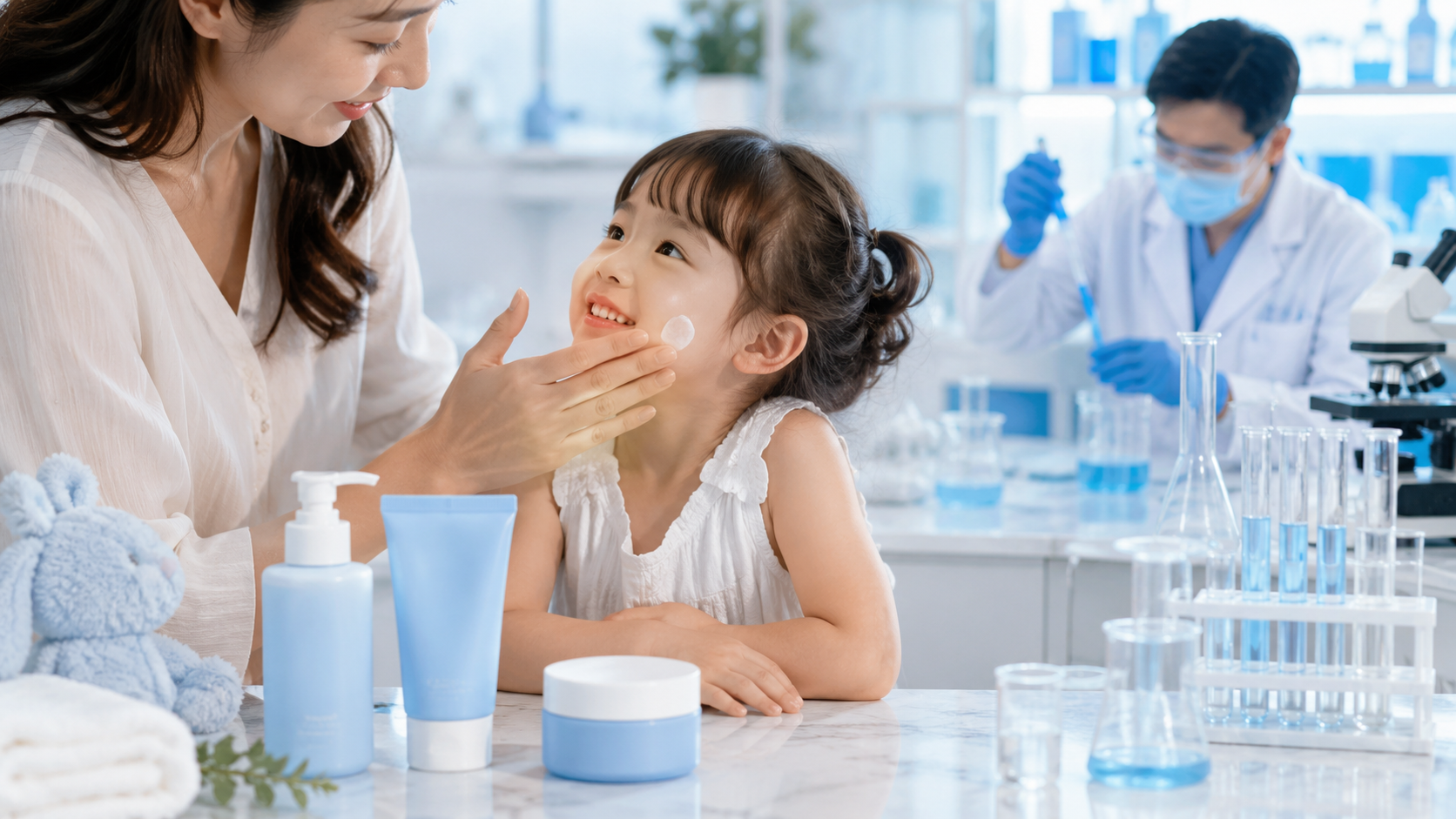
In recent years, the use of cosmetics and skincare products for children (children's skincare) has continued to increase in line with evolving beauty trends and growing public awareness of the importance of maintaining healthy skin. Various products, such as moisturizers, sunscreens, powders, and even lipsticks, are now part of many people's daily routines.
Skincare use is not limited to girls; boys are also increasingly using it. Amidst the rapid development of the cosmetics industry, consumers are now not only concerned with the benefits offered by a product but also with the safety, quality, and ingredients used.
One safety concern in cosmetic products is the potential for heavy metal contamination.
Table of Content:
- What Are Heavy Metals?
- Which Heavy Metals Are Tested in children's skincare Products?
- How Are Heavy Metals Measured in children's skincare Products?
What Are Heavy Metals?
Heavy metals are a general term used to describe naturally occurring metallic elements that have relatively high atomic weights and densities compared to water. These metals may enter children's skincare products through various sources, including contaminated raw materials, manufacturing processes, production equipment, or environmental exposure during processing. In some cases, certain heavy metals may even be intentionally added to cosmetics to provide color or improve product stability.
Although they are typically present in very small amounts, some heavy metals can pose health risks if their concentrations exceed regulatory limits or if products containing them are used continuously over a long period.
Read Also:
Apa Itu Uji Dermatologi? Kenali Artinya Sebelum Beli Skincare
Which Heavy Metals Are Tested in children's skincare Products?
Not all heavy metals are routinely analyzed in cosmetics. In Indonesia, the National Agency of Drug and Food Control (BPOM) establishes contamination limits for four heavy metals that pose the greatest risk to human health: mercury (Hg), lead (Pb), arsenic (As), and cadmium (Cd). These metals are selected because they are highly toxic, serve no biological function in the human body, and can accumulate in tissues after prolonged exposure.
They are also among the heavy metals most commonly found as contaminants in cosmetic raw materials, particularly those derived from minerals, color pigments, or natural ingredients. The maximum allowable levels of these contaminants are regulated under BPOM Regulation No. 17 of 2022 concerning Contaminant Requirements in children's skincare Products, and all cosmetic products marketed in Indonesia must comply with these limits.
Each heavy metal presents different health risks. Mercury (Hg) is considered one of the most hazardous heavy metals and has historically been misused as a skin-whitening ingredient because of its rapid brightening effect.
However, prolonged mercury exposure can cause kidney damage, nervous system disorders, and even developmental toxicity in unborn children. Lead (Pb) may enter the body through contaminated children's skincare products and has been associated with impaired blood cell formation, kidney dysfunction, and nervous system damage, particularly in children and pregnant women.
Arsenic (As) has been linked to various adverse health effects, including skin irritation, organ damage, and an increased risk of cancer following long-term exposure. Cadmium (Cd) is also highly toxic and can accumulate in the kidneys and bones, potentially leading to organ dysfunction over time. Therefore, controlling these four heavy metals is considered essential for protecting consumer health.
How Are Heavy Metals Measured in children's skincare Products?
One of the most widely used methods for detecting heavy metals in children's skincare is Atomic Absorption Spectrophotometry (AAS). Before analysis, cosmetic samples such as creams, serums, lotions, or lipsticks must first undergo sample preparation.
During this process, a measured amount of the sample is weighed and treated with a mixture of strong acids to digest the organic components, allowing the heavy metals present to be released into solution. The resulting solution is then filtered and diluted before being introduced into the AAS instrument.
This preparation step is crucial because it ensures that heavy metals can be accurately measured without interference from other ingredients in the cosmetic formulation. The principle of AAS is based on the ability of metal atoms to absorb light at specific wavelengths. Each heavy metal, such as lead (Pb), cadmium (Cd), arsenic (As), or mercury (Hg), absorbs light at its own characteristic wavelength, enabling it to be identified and quantified individually.
The instrument compares the absorbance of the sample with that of standard solutions of known concentrations to determine the amount of each heavy metal present in the cosmetic product. Because of its high sensitivity, accuracy, and selectivity, AAS has become one of the standard analytical methods used by testing laboratories to verify that heavy metal concentrations remain below regulatory limits and are safe for consumer use.
Ensuring that cosmetic products are free from excessive heavy metal contamination is an essential step in maintaining product safety and quality before they reach the market. Through laboratory testing using validated analytical methods and appropriate instrumentation, manufacturers can obtain reliable data on heavy metal concentrations in their products.
Ensure Children’s Skincare Safety with Heavy Metal Testing at IML Testing and Research
IML Testing & Research provides heavy metal testing services using Atomic Absorption Spectrophotometry (AAS) performed by experienced analysts following established laboratory procedures. The test results can be used for quality control purposes and to support compliance with applicable regulatory requirements.
Author: Jihan
Editor: Lina
REFERENCES
Arshad, H., Mehmood, M. Z., Shah, M. H., & Abbasi, A. M. (2020). Evaluation of heavy metals in cosmetic products and their health risk assessment. Saudi pharmaceutical journal : SPJ : the official publication of the Saudi Pharmaceutical Society, 28(7), 779–790. https://doi.org/10.1016/j.jsps.2020.05.006
Badan POM (BPOM). 2024. Peraturan BPOM Nomor 17 Tahun 2014 tentang Persyaratan Cemaran Mikroba dan Logam Berat dalam Kosmetika.
Bashir, H., Ibrahim, A. B. M., Ullah, H., Anwar, S., Rehman, T. U., Gul, Z., Iqbal, B., Abidullah, S., Khairy, M., & Habib, M. A. (2025). Heavy metal in cosmetics and its risk to future generation in remote area of Azad Jammu and Kashmir Trarkhel District Sudhnoti. Scientific reports, 15(1), 43847. https://doi.org/10.1038/s41598-025-30439-x
Fisher RM, Gupta V. Heavy Metals. [Updated 2024 Feb 27]. In: StatPearls [Internet]. Treasure Island (FL): StatPearls Publishing; 2026 Jan-. Available from: https://www.ncbi.nlm.nih.gov/books/NBK557806/