


The Importance of Rice Seed Testing: Germination, Purity, and Moisture Content

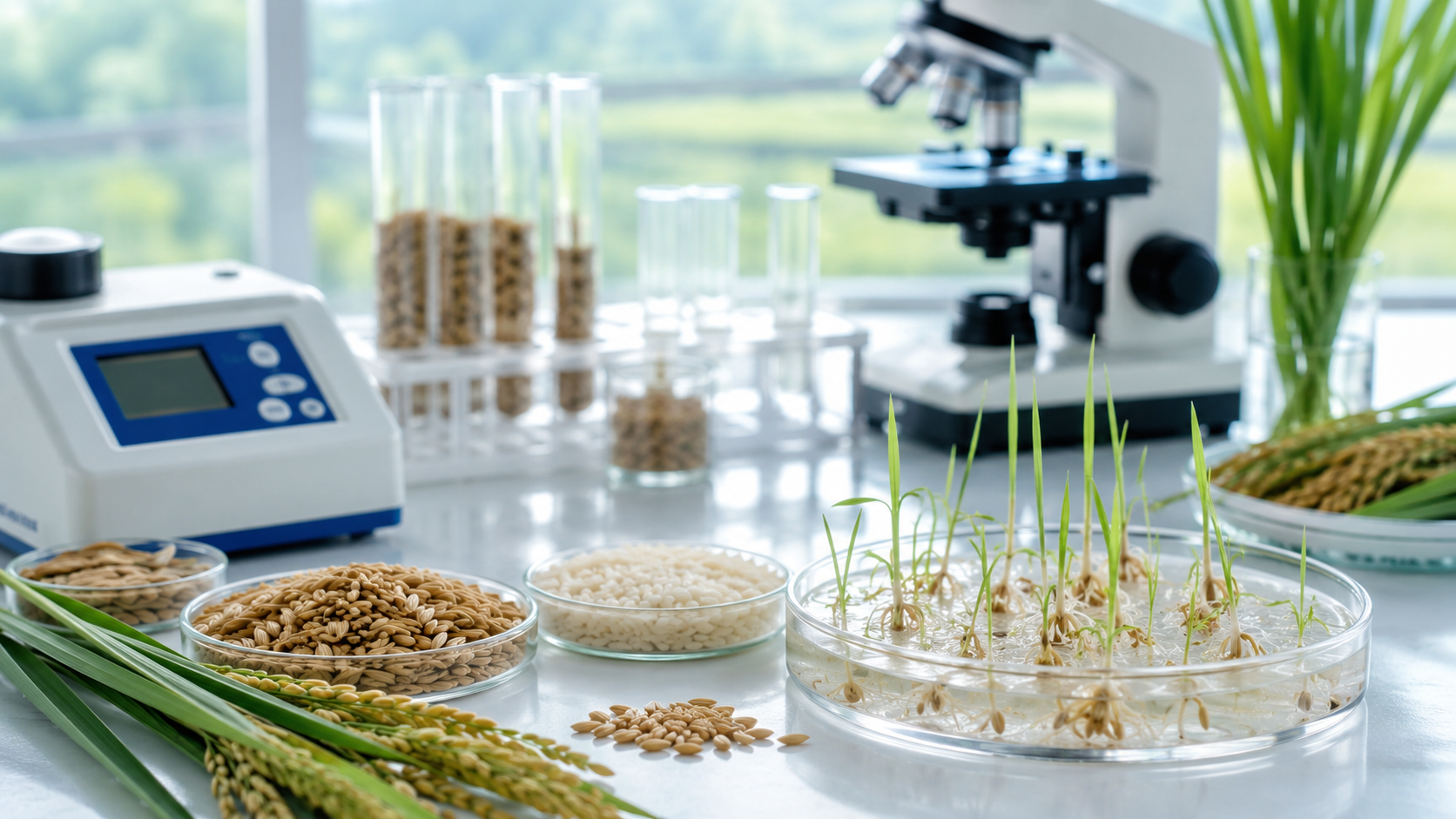
Seed quality is one of the earliest factors affecting the successful establishment of a rice crop. Seeds that appear clean, full, and uniform do not necessarily have high germination potential, adequate varietal purity, or suitable moisture content for storage.
High-quality seed supports more uniform establishment, reduces the need for replanting, and contributes to healthy early crop growth. The International Rice Research Institute identifies germination, varietal purity, physical purity, and moisture content as important parameters for evaluating rice seed quality.
Therefore, producers and distributors should not assess rice seed solely by its color, size, or appearance. Laboratory testing is required to verify that a seed lot meets the intended germination, purity, and moisture specifications.
Daftar Isi:
- Why Should Rice Seed Quality Be Tested?
- How the Three Parameters Work Together
- Additional Tests to Consider
- Bridging Visual Quality and Laboratory Evidence
Why Should Rice Seed Quality Be Tested?
Seed quality may change during production, harvesting, drying, processing, packaging, transportation, and storage. Mechanical damage, high humidity, pest infestation, varietal mixing, and improper storage may reduce the quality of an otherwise promising seed lot.
Seed testing evaluates physical characteristics and physiological quality using a representative sample from the lot. The resulting data provide an objective basis for determining whether the product is suitable for distribution or planting.
Three of the most commonly evaluated parameters are germination, purity, and moisture content.
Read Also:
4 Components and Factors of Seed Quality as the Basis for Laboratory Testing
1. Rice Seed Germination Testing
A germination test determines the percentage of seeds capable of producing normal seedlings under favorable and controlled conditions. The test uses defined media, temperature, moisture, light, and evaluation periods.
The results may classify seeds as:
- normal seedlings;
- abnormal seedlings;
- dead seeds; and
- hard, fresh, or dormant seeds when applicable.
The USDA describes germination testing as reporting the percentages of normal, abnormal, dead, and dormant seeds under ideal germination conditions.
2. Rice Seed Purity Testing
Physical-purity testing determines the composition of a seed lot. The working sample is separated into components such as:
- pure seed;
- other crop seed;
- weed seed; and
- inert matter.
Inert matter may include soil, stones, empty hulls, straw, broken material, or other non-seed components. Each component is weighed and reported as a percentage of the sample.
According to the USDA, physical-purity testing reports the proportions of pure seed, inert matter, other crop seed, and weed seed present in a lot.
3. Rice Seed Moisture Testing
Moisture testing determines the amount of water present in the seed at the time of analysis. This parameter is important because moisture influences respiration, metabolic activity, microbial growth, deterioration, and storage longevity.
Seed with excessive moisture may be more susceptible to heating, mold growth, and loss of viability. Inappropriate or overly intensive drying may also injure the seed and reduce its ability to germinate.
IRRI recommends keeping rice seed moisture below 14%, and preferably below 12% when longer storage is intended. However, the appropriate target should reflect the packaging system, storage temperature and humidity, intended storage period, and applicable quality requirements.
Tahir and colleagues reported that rice seed stored at moisture contents of 10% and 12% maintained better quality than seed stored at 14%. Higher moisture accelerated the decline in germination and seed longevity, particularly when oxygen remained available in the storage environment.
How the Three Parameters Work Together
Germination, purity, and moisture provide different but complementary information. A seed lot may have high physical purity but poor germination because it has been stored for too long.
Another lot may germinate well but fail to meet product specifications because it contains weed seed, another rice variety, or excessive inert matter. Moisture content also affects how germination changes during storage and distribution. Therefore, no single parameter can replace the others.
A comprehensive evaluation helps answer three essential questions:
- Can the seed produce normal seedlings?
- Is the lot clean and consistent with its declared identity?
- Is its moisture content suitable for safe storage and distribution?
Additional Tests to Consider
Rice seed evaluation may also include:
Seed-vigor testing
Vigor testing evaluates the ability of seed to germinate rapidly and uniformly and to establish under less favorable conditions.
Tetrazolium viability testing
This biochemical method helps identify living seed tissue and can be useful for dormant or freshly harvested seeds.
Seed-health testing
Seed-health analysis detects fungi, bacteria, and other seed-borne pathogens that may reduce germination or transmit disease to seedlings.
Thousand-seed weight
Thousand-seed weight provides information about seed size, density, and uniformity and may support seeding-rate calculations.
Variety-identity testing
Morphological, field, electrophoretic, or molecular methods may be used to confirm whether a seed lot matches the declared variety.
Bridging Visual Quality and Laboratory Evidence
Full, uniform, and clean-looking seed may suggest good physical condition. However, appearance cannot demonstrate whether the embryo remains viable, the moisture content is suitable, or the lot is free from undesirable mixtures.
Laboratory evidence allows producers to establish specifications, compare production batches, evaluate drying and storage practices, and support labeling information with measurable results.
Representative sampling is also essential. A sample that does not adequately represent the seed lot may produce results that fail to reflect the product’s actual quality.
Test Your Rice Seed at IML Testing & Research
Rice seed quality cannot be confirmed through appearance alone. Consult and conduct rice seed testing at IML Testing & Research to evaluate germination, physical purity, moisture content, and other relevant quality parameters.
Appropriate testing data can help producers maintain batch consistency, evaluate storage suitability, strengthen technical documentation, and increase customer confidence before distribution.
Author & Editor: Lina
References
Food and Agriculture Organization of the United Nations. (2018). Seeds Toolkit: Module 3—Seed Quality Assurance. FAO.
International Rice Research Institute. (n.d.). Seed Quality. Rice Knowledge Bank.
United States Department of Agriculture, Agricultural Marketing Service. (n.d.). Seed Testing Program.
Tahir, A., Afzal, I., Khalid, E., Razzaq, M., & Arif, M. A. R. (2023). Rice seed longevity in the context of seed moisture contents and hypoxic conditions in the storage environment. Seed Science Research, 33(1), 39–49. DOI: 10.1017/S0960258522000289.
Bewley, J. D., Bradford, K. J., Hilhorst, H. W. M., & Nonogaki, H. (2013). Seeds: Physiology of Development, Germination and Dormancy (3rd ed.). Springer.
Copeland, L. O., & McDonald, M. B. (2001). Principles of Seed Science and Technology (4th ed.). Kluwer Academic Publishers.
Association of Official Seed Analysts. (2009). Seed Vigor Testing Handbook. AOSA.