Time Kill Assay Testing Standards and Strategies for Assessing the Speed of Antimicrobial Activity


In modern microbiology, the pharmaceutical industry, and personal care manufacturing, measuring only the Minimum Inhibitory Concentration (MIC) is often insufficient to prove a product's true market superiority. This limitation makes the time kill assay an indispensable tool for dynamically evaluating the rate and speed of microbial eradication.
Static assays evaluated at a single time point fail to answer a critical operational question: How fast can an antimicrobial agent neutralize or eradicate target microorganisms? To address this challenge, the Time Kill Assay (kill kinetics test) serves as the dynamic industry gold standard.
At IML Testing and Research, this method is rigorously and professionally applied to provide empirical data for industrial clients seeking to validate their antimicrobial product claims.
Table of Content:
- What is a Time Kill Assay?
- International Regulatory Testing Standards
- Laboratory Workflow and Procedures
What is a Time Kill Assay?
A time kill assay is an in vitro method designed to measure the rate of population reduction in microorganisms (bacteria or fungi) over time when exposed to an antimicrobial agent at specific concentrations. Unlike static assays, this procedure yields a time-kill curve that documents continuous antimicrobial activity—ranging from seconds and minutes to a full 24-hour observation period.
This approach is essential for classifying whether a substance is bacteriostatic (inhibiting growth) or bactericidal (actively killing microbial cells) based on specific reduction thresholds, such as a $\ge 3-\text{log}_{10}$ (99.9%) decrease in viable cell count.
Read Also:
Time-Kill Assay: A Method to Evaluate How Quickly Microorganisms Are Killed
International Regulatory Testing Standards
Execution of the time kill assay follows globally recognized standards to ensure analytical precision, reproducibility, and reliability:
1. CLSI M26-A (Clinical and Laboratory Standards Institute)
The benchmark guideline for evaluating the bactericidal activity of pharmaceutical antimicrobials using standardized initial inocula ($5 \times 10^5$ to $1 \times 10^6 \text{ CFU/mL}$).
2. ASTM E2315 (Standard Test Method for Time-Kill Antimicrobial Activity)
Widely utilized for disinfectants, antiseptics, and consumer care formulations requiring rapid contact-time evaluations spanning seconds to minutes.
Laboratory Workflow and Procedures
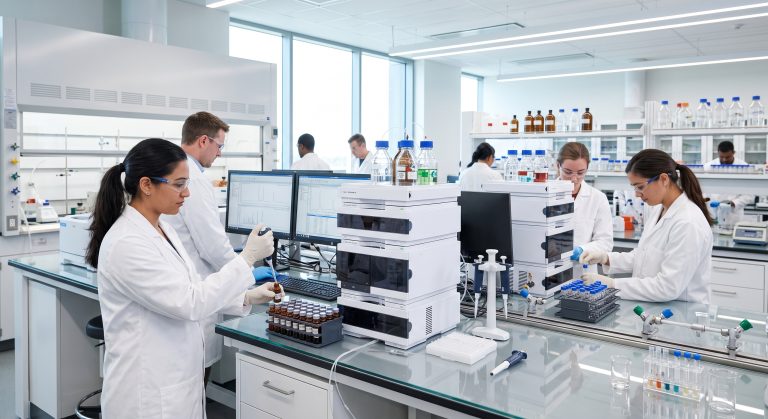
The execution of a time kill assay involves systematic stages managed under stringent quality control by experienced microbiologists:
1. Inoculum Preparation
Test microbial cultures are cultivated to the logarithmic growth phase and standardized to precise cell densities.
2. Agent Exposure
The target antimicrobial substance is introduced into the test system containing the standardized microbial suspension.
3. Serial Sampling
At predetermined time intervals (e.g., 0, 1, 2, 4, 6, and 24 hours), test aliquots are withdrawn and immediately mixed with a targeted neutralizing agent to halt antimicrobial action instantly.
4. Colony Enumeration
Samples are plated onto nutrient agar plates, incubated under optimal conditions, and surviving colonies ($\text{CFU/mL}$) are counted to plot log reduction curves over time.
Optimize Your Product Efficacy Today
Ready to substantiate your product's antimicrobial efficacy using rigorous scientific standards? IML Testing and Research is fully equipped to support your product development, regulatory compliance, and quality benchmarking through comprehensive microbiological testing services.
Contact our expert team today to discuss your customized testing protocols!
Author & Editor: Lina
References
Clinical and Laboratory Standards Institute (CLSI). (1999). Methods for Determining Bactericidal Activity of Antimicrobial Agents; Approved Guideline. CLSI Document M26-A. Wayne, PA.
ASTM International. (2023). ASTM E2315-23: Standard Test Method for Assessment of Antimicrobial Activity Using a Time-Kill Procedure. West Conshohocken, PA.
Hossain, T. J. (2024). Methods for Screening and Evaluation of Antimicrobial Activity: A Review of Protocols, Advantages, and Limitations. European Journal of Microbiology and Immunology, 14(2), 97-115. DOI: 10.1556/1886.2024.00035.
Murray, P. R., Rosenthal, K. S., & Pfaller, M. A. (2020). Medical Microbiology (9th ed.). Elsevier.
National Committee for Clinical Laboratory Standards (NCCLS). (2009). Methods for Determining Bactericidal Activity of Antimicrobial Agents. Approved Standard M26-A. Wayne, PA.