Can Polymers Be Tested Using HPLC? Understanding the Possibilities and Limitations

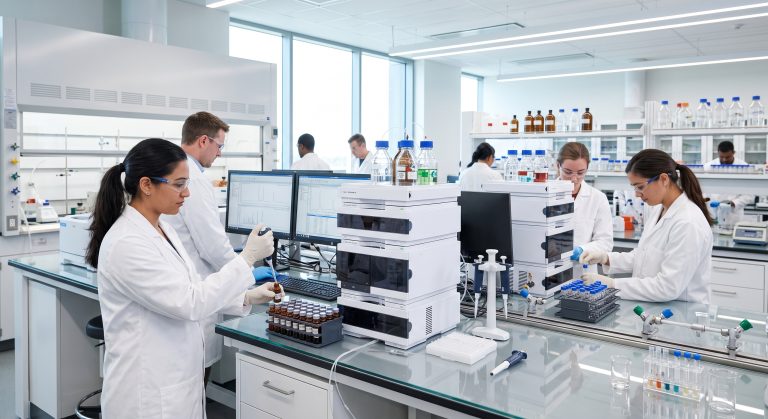
High Performance Liquid Chromatography (HPLC) is one of the analytical techniques widely used to separate, identify, and quantify various compounds. But what if the sample being analyzed is a polymer?
This is a common question because polymers have different characteristics from small-molecule compounds. Their large molecular size, complex structures, molecular weight distribution, and limited solubility require careful consideration when selecting an analytical method for polymer testing.
Table of Content:
- Can All Types of Polymers Be Analyzed Using HPLC?
- What Types of Polymers Can Be Analyzed Using HPLC?
- How Are Polymer Samples Prepared for HPLC Analysis?
- Why Can’t Polymers Always Be Analyzed Directly Using HPLC?
Can All Types of Polymers Be Analyzed Using HPLC?
Not all polymers can be directly analyzed using conventional HPLC under the same conditions. The analytical approach is strongly influenced by the characteristics of the polymer, particularly its molecular weight, solubility, polarity, chemical structure, and interactions with the stationary and mobile phases.
HPLC essentially separates components based on interactions between the analyte, stationary phase, and mobile phase. Therefore, a polymer must be in a suitable condition to enter the chromatographic system and interact appropriately with the selected analytical method.
For polymers with very high molecular weights, solubility can be one of the major challenges. An incompletely dissolved sample may cause filter or column blockage, produce unrepresentative chromatograms, and potentially interfere with the HPLC system.
However, these limitations do not mean that polymers cannot be analyzed using liquid chromatography techniques. The development of polymer liquid chromatography has demonstrated that HPLC can be used to fractionate polymers based on various parameters, including molecular size, chemical composition, functionality, branching, and tacticity under appropriate conditions.
Read Also:
HPLC RID vs DAD: Don’t Choose the Wrong Detector for Your Analysis!
What Types of Polymers Can Be Analyzed Using HPLC?
The types of polymers that can be analyzed depend greatly on the purpose of the test and the parameters to be determined. Several chromatographic approaches can be applied to polymer analysis.
One of them is Size Exclusion Chromatography (SEC), also known as Gel Permeation Chromatography (GPC), which is widely used to characterize molecular size and molar mass distribution. IUPAC defines size-exclusion chromatography as a separation technique primarily based on differences in the hydrodynamic volume of molecules or particles in solution.
This makes SEC/GPC particularly relevant when the objective is to characterize the molecular weight and distribution of polymer molecules. Meanwhile, conventional HPLC may be more relevant when the analytical target is a specific component associated with a polymer, such as residual monomers, oligomers, additives, or degradation products.
How Are Polymer Samples Prepared for HPLC Analysis?
Sample preparation is one of the important stages in polymer testing. Unlike simple solution samples, polymer materials may have complex matrices and may not always dissolve easily in solvents compatible with an HPLC system.
Sample preparation may involve solvent selection, dissolution or extraction, dilution, filtration, and separation of specific components from the polymer matrix. The preparation conditions should be selected based on the characteristics of the sample and the analytical target.
Solubility is a particularly important factor. The selected solvent must be capable of adequately dissolving the polymer or extracting the target analyte without causing problems within the chromatographic system.
In addition, filter selection should also be carefully considered. Insoluble particles can enter the system and increase the risk of blockage, potentially affecting chromatographic performance and analytical results.
Why Can’t Polymers Always Be Analyzed Directly Using HPLC?
The answer depends on the purpose of the analysis. If the objective is to determine residual monomers, HPLC may be a relevant analytical approach. However, if the objective is to determine molecular weight (Mn or Mw) and molecular weight distribution/dispersity (Đ), SEC/GPC is generally a more appropriate approach.
SEC separates molecules primarily according to their size or hydrodynamic volume. Because polymers typically consist of molecules with a range of molecular weights rather than a single molecular weight, SEC/GPC can provide information about the distribution of these polymer molecules.
SEC is part of the liquid chromatography family and is widely used for polymer characterization. The separation can be combined with different detectors to obtain information about molecular weight and its distribution.
For example, SEC coupled with multi-angle light scattering (SEC-MALS) can provide information on absolute molecular weight using an approach that differs from conventional SEC based on calibration standards. Therefore, selecting an analytical method for polymer testing should begin with a clear understanding of the target parameter.
HPLC may be suitable for analyzing specific compounds associated with polymers, while SEC/GPC and other advanced techniques may be more appropriate for polymer molecular weight and structural characterization.
Need Accurate Polymer Characterization Testing?
Don't guess when it comes to the quality and composition of your polymer materials. Trust your laboratory analysis to IML Testing and Research.
We provide precise, reliable, and industry-standard analytical testing services. Contact our team of experts today and get a free consultation to find the most appropriate testing method for your products!
Author: Elmira
Editor: Lina
References
International Union of Pure and Applied Chemistry. (2025). Size-exclusion chromatography. In IUPAC Compendium of Chemical Terminology (the Gold Book). https://doi.org/10.1351/goldbook.S05705
Matson, J. B., Steele, A. Q., Mase, J. D., & Schulz, M. D. (2024). Polymer characterization by size-exclusion chromatography with multi-angle light scattering (SEC-MALS): A tutorial review. Polymer Chemistry, 15(3), 127–142. https://doi.org/10.1039/D3PY01181J
Pasch, H., & Bungu, P. E. (2024). 45 years of polymer HPLC: A short review. Macromolecular Materials and Engineering, 309(8), 2300354. https://doi.org/10.1002/mame.202300354