5 Reasons Why SCOBY Should Be Laboratory-Tested Before Kombucha Production

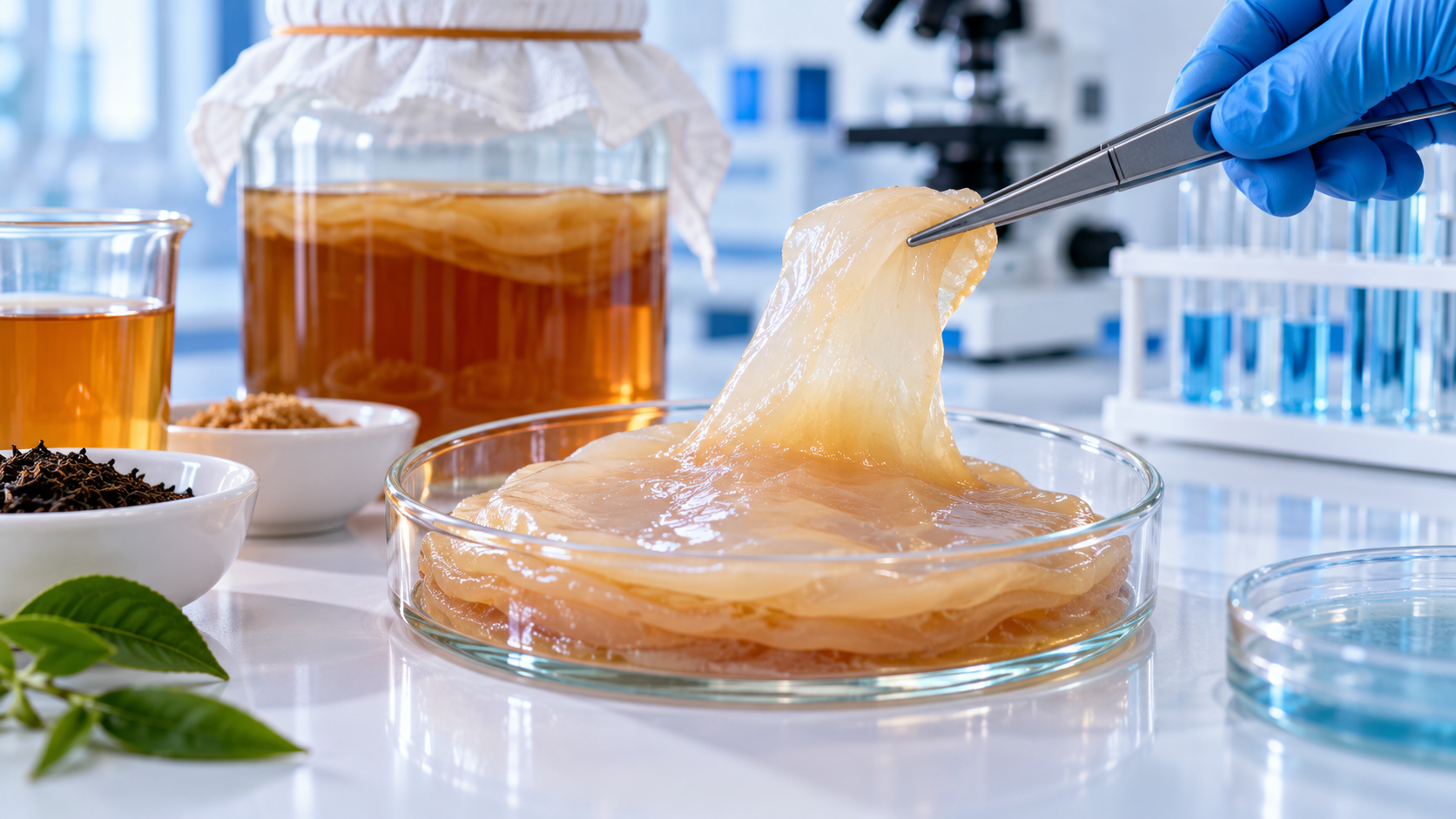
Kombucha is a fermented beverage generally produced from sweetened tea using SCOBY (Symbiotic Culture of Bacteria and Yeast). This culture contains a microbial community—particularly acetic acid bacteria and yeasts—that contributes to fermentation and metabolite production.
Its microbial composition can vary depending on the raw materials, starter culture, and fermentation conditions. In kombucha production, SCOBY quality is an important consideration because the culture interacts directly with the fermentation substrate.
For commercial production, visual appearance alone cannot provide complete information about the microbiological characteristics of the starter culture. So, why should SCOBY be tested before being used for kombucha production?
Table of Content:
- Understand the Microbial Composition of SCOBY
- Help Detect Microbial Contamination
- Support Fermentation Consistency
- Evaluate Starter Cultures Before Scale-Up
- Support Kombucha Quality Control
Understand the Microbial Composition of SCOBY
SCOBY is not a single microorganism. It is a microbial community containing different bacteria and yeasts.
Reported microorganisms include acetic acid bacteria such as Acetobacter, Gluconobacter, and Komagataeibacter, along with several yeast genera. Microbial composition may vary among cultures. Laboratory analysis can therefore provide information about microorganisms associated with a culture.
When more specific identification is required, molecular approaches may also be considered depending on the analytical objective.
Read Also:
What is SCOBY in Kombucha and How is it Made? Complete Discussion Here!
Help Detect Microbial Contamination
Fermentation intentionally involves microbial activity. However, not every microorganism present in a fermentation environment is necessarily part of the desired culture.
Contamination may be influenced by raw materials, equipment hygiene, the production environment, starter handling, and storage conditions. Scientific literature on kombucha production also highlights contamination prevention and process control as relevant considerations.
Microbiological examination can therefore form part of quality control when evaluating starter cultures before production.
Support Fermentation Consistency
Microorganisms in SCOBY participate in biochemical transformations during fermentation. Yeasts metabolize sugars, while acetic acid bacteria contribute to organic-acid and bacterial-cellulose production.
These microbial interactions influence the dynamics of kombucha fermentation. Significant differences in starter-culture conditions between batches may contribute to variations in fermentation characteristics.
Monitoring the culture can therefore provide useful information for supporting a more controlled production process.
Evaluate Starter Cultures Before Scale-Up
Commercial kombucha production generally requires greater process control than household fermentation. Substrate composition, temperature, fermentation time, and microbial communities can influence fermentation dynamics.
Before a SCOBY is repeatedly propagated or introduced into larger-scale production, laboratory evaluation can provide information about the characteristics of the starter culture. These data can contribute to starter-culture evaluation, process standardization, and quality-control programs.
Support Kombucha Quality Control
Quality management for fermented beverages does not begin only with the finished product. Control can start with raw materials and starter cultures.
Scientific literature on kombucha production emphasizes the importance of controlling processing, quality, and safety parameters, particularly as production moves toward commercial scale. Testing SCOBY can form one part of this quality-control approach.
However, starter-culture testing does not replace finished-product analysis. The final kombucha may still require microbiological, chemical, and other quality evaluations according to the product's requirements and applicable standards.
What Can Be Tested in SCOBY?
Testing parameters should be selected according to the analytical objective. Evaluation may include profiling or quantification of selected microorganisms, microbiological examination for contamination, and microbial identification using appropriate methods.
When more specific microbial identification is needed, molecular biology techniques based on DNA analysis may be considered. In contrast, general microbial enumeration or contamination testing falls under microbiological testing and should not automatically be classified as molecular biology.
Understand Your SCOBY Before Using It for Production
Starter cultures play an important role in kombucha fermentation. Understanding the microorganisms associated with SCOBY can help manufacturers develop a more measurable approach to production and quality control.
Through laboratory testing at IML Testing & Research, analytical parameters can be selected according to the testing objective, including Molecular Biology approaches when specific microbial identification is required.
Contact IML Testing & Research to discuss SCOBY testing and determine suitable analytical parameters and methods for your production needs.
Author & Editor: Lina
References
Villarreal-Soto, S. A., Beaufort, S., Bouajila, J., Souchard, J. P., & Taillandier, P. (2018). Understanding kombucha tea fermentation: A review. Journal of Food Science, 83(3), 580–588.
Laavanya, D., Shirkole, S., & Balasubramanian, P. (2021). Current challenges, applications and future perspectives of SCOBY cellulose of Kombucha fermentation. Journal of Cleaner Production, 295, 126454.
Ivanišová, E., et al. (2023). Microbiology and antimicrobial effects of kombucha, a short overview. Food Bioscience, 56, 103270.
Antolak, H., Piechota, D., & Kucharska, A. (2021). Kombucha tea—A double power of bioactive compounds from tea and symbiotic culture of bacteria and yeasts (SCOBY). Antioxidants, 10(10), 1541.
Jayabalan, R., & Waisundara, V. Y. (2019). Kombucha drink: Production, quality, and safety aspects. In Production and Management of Beverages: The Science of Beverages (Vol. 1, pp. 259–288). Woodhead Publishing/Elsevier.
Lima, A. R., de Miranda, J. F., Silva, K. A., & Uekane, T. M. (2025). Safety aspects and toxicological studies in kombucha and its analogs. In Kombucha: Technology, Traceability, and Health-Promoting Effects (pp. 275–293). Academic Press.
Greenwalt, C. J., Steinkraus, K. H., & Ledford, R. A. (2000). Kombucha, the fermented tea: Microbiology, composition, and claimed health effects. Journal of Food Protection, 63(7), 976–981.