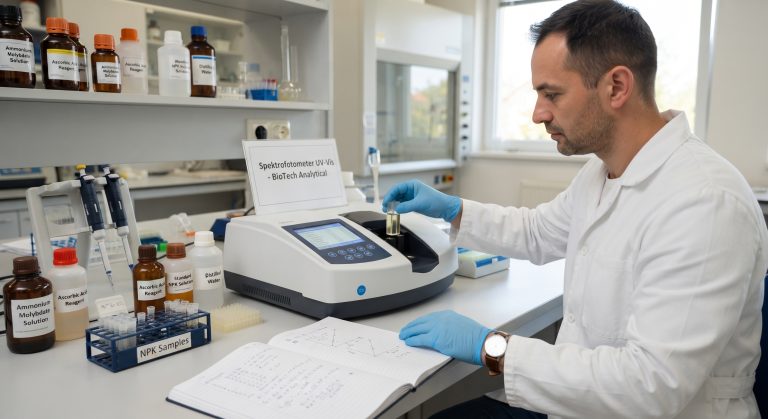
5 Benefits of Laboratory Testing for Urea Fertilizer to Maintain Product Quality and Consistency


Urea fertilizer is one of the most widely used nitrogen sources in agriculture. Nitrogen plays an important role in supporting vegetative plant growth, including leaf and stem development and various metabolic processes.
Chemically, urea has the formula CO(NH₂)₂ and contains a high proportion of nitrogen. However, product quality cannot be evaluated solely from physical appearance or the information provided on the packaging.
Manufacturers need to ensure that the chemical characteristics of their products meet established quality specifications. Therefore, laboratory testing of urea fertilizer can be an important part of quality control.
Analytical testing provides measurable data that can help manufacturers evaluate both raw materials and finished products. What are the main benefits?
Table of Content:
- Determine Nitrogen Content in Urea Fertilizer
- Help Evaluate Product Purity
- Maintain Batch-to-Batch Consistency
- Support Quality Control with Analytical Data
- Help Verify Product Specifications
- What Parameters Can Be Tested?
Determine Nitrogen Content in Urea Fertilizer
Nitrogen content is one of the key parameters used to evaluate the quality of urea fertilizer. A nitrogen concentration that does not meet specifications may affect product quality and the amount of nutrient available to plants.
Laboratory analysis can determine nitrogen content using an appropriate analytical method. The results can then be compared with product specifications or relevant standards.
For manufacturers, these data help verify whether the finished product meets established quality targets.
Read Also:
Urea Fertilizer and Nitrogen Content: Why It Must Be Verified with Laboratory Test Data
Help Evaluate Product Purity
In addition to nitrogen content, the quality of urea fertilizer may be influenced by other components originating from raw materials or formed during manufacturing. One parameter that may require attention is biuret.
This compound can form during urea manufacturing under certain heating conditions. Excessive concentrations may be a concern, particularly for certain plant applications.
Laboratory testing provides analytical data on relevant parameters, allowing manufacturers to evaluate product quality beyond physical appearance alone.
Maintain Batch-to-Batch Consistency
Products manufactured in different batches should ideally maintain relatively consistent characteristics within established specifications. However, variations in raw materials, processing conditions, storage, and other manufacturing factors may affect the characteristics of urea fertilizer.
Regular laboratory testing allows manufacturers to compare analytical data between batches. When results fall outside established specifications, quality-control teams can investigate potential causes in raw materials or production processes before distribution.
Laboratory analysis can therefore support consistent product quality over time.
Support Quality Control with Analytical Data
Effective quality control requires objective and measurable information. Visual inspection alone cannot provide complete information about a product's chemical characteristics.
Laboratory testing of urea fertilizer allows selected parameters to be measured using appropriate analytical methods. In addition to nitrogen and biuret, other parameters may be selected according to product specifications, analytical requirements, and applicable standards.
The resulting data can support quality-control documentation, manufacturing-process evaluation, and verification of product specifications.
Help Verify Product Specifications
Information about nutrient content should be supported by appropriate analytical data, particularly when a manufacturer declares specific values as part of its urea fertilizer specifications. Laboratory testing can help verify whether measured parameters fall within the established specification range.
However, analytical parameters and testing methods should be selected according to the product type and testing objective. Appropriate methods are important to ensure that laboratory results can effectively support quality evaluation.
What Parameters Can Be Tested?
Testing parameters for urea fertilizer may vary depending on product requirements and applicable standards. Parameters commonly considered include nitrogen content, moisture or water content, biuret, and other chemical characteristics relevant to the product specification.
Manufacturers should therefore select analytical parameters based on product characteristics, quality-control requirements, and the standards used as references.
Verify Urea Fertilizer Quality Through Laboratory Testing
The quality of urea fertilizer cannot be evaluated solely through its physical appearance. Laboratory data can help determine chemical composition, evaluate batch-to-batch consistency, and verify compliance with established product specifications.
Through Chemical Compound Testing at IML Testing & Research, manufacturers can evaluate relevant parameters using analytical methods selected according to their product and testing requirements.
Contact IML Testing & Research to discuss your urea fertilizer laboratory testing needs and support product quality control with measurable analytical data.
Author & Editor: Lina
References
Havlin, J. L., Tisdale, S. L., Nelson, W. L., & Beaton, J. D. (2014). Soil Fertility and Fertilizers: An Introduction to Nutrient Management. 8th ed. Pearson.
Mengel, K., Kirkby, E. A., Kosegarten, H., & Appel, T. (2001). Principles of Plant Nutrition. 5th ed. Springer.
Marschner, P. (Ed.). (2012). Marschner's Mineral Nutrition of Higher Plants. 3rd ed. Academic Press.
Finck, A. (1982). Fertilizers and Fertilization: Introduction and Practical Guide to Crop Fertilization. Verlag Chemie.
UNIDO & IFDC. (1998). Fertilizer Manual. 3rd ed. Kluwer Academic Publishers.
Cooke, G. W. (1982). Fertilizing for Maximum Yield. 3rd ed. Granada Publishing.