Botanical Pesticides and Strategies Toxicity Testing: Why Do Natural Ingredients Still Need to Be Tested?

Botanical pesticides are increasingly explored as alternatives for pest management because their active ingredients originate from plants. However, a natural origin does not automatically guarantee that a product is safe for humans, animals, or the environment.
Plants produce biologically active compounds that may help control pests. Nevertheless, these compounds can also raise safety concerns when exposure occurs through the skin, mouth, or respiratory system.
Therefore, toxicity testing plays an important role in botanical pesticide development, particularly in generating data on potential hazards before products are widely used or marketed.
Table of Content:
- What Are Botanical Pesticides?
- Why Do Botanical Pesticides Require Toxicity Testing?
- The Role of Toxicity Testing in Product Development
What Are Botanical Pesticides?
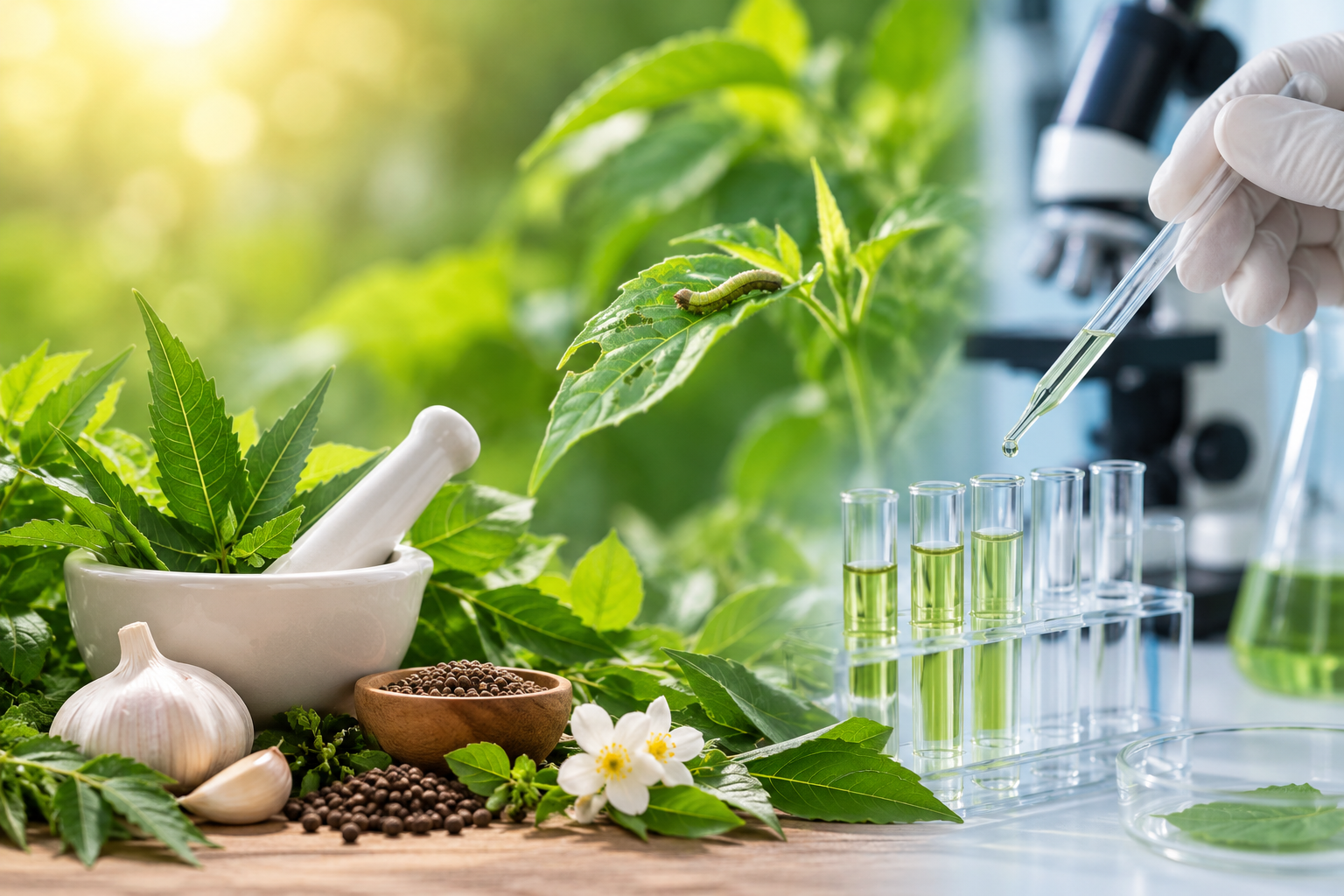
Botanical pesticides are pest control products that use active compounds derived from plants, including leaves, seeds, roots, flowers, and bark. Examples of botanical pesticide ingredients include azadirachtin from neem, pyrethrins from certain chrysanthemum species, and compounds found in essential oils.
Isman (2020) discusses the potential of neem-based insecticides, pyrethrum, and essential oils in crop protection while highlighting challenges related to product development and commercialization. Consequently, the safety of these products should be evaluated according to their chemical characteristics rather than their natural origin alone.
Read Also:
Common Mistakes When Mixing Botanical Pesticides That Can Reduce Product Effectiveness
Why Do Botanical Pesticides Require Toxicity Testing?
1. Natural Ingredients Contain Bioactive Compounds
Plants produce secondary metabolites that help protect them against pests. These compounds may affect insect nervous systems, growth, feeding behavior, or other physiological processes.
However, their biological activity is not necessarily limited to target organisms. Rotenone, for example, is a plant-derived compound historically used as an insecticide.
Research demonstrates that botanical pesticide ingredients have different toxicological characteristics and require substance-specific evaluation. Toxicity testing can therefore help identify potential adverse effects associated with active ingredients and finished formulations.
2. Active Ingredient Concentration Influences Potential Hazards
Concentration is an important consideration in product safety evaluation. A dilute plant extract may have different characteristics from a concentrated extract.
Extraction methods can also produce different chemical compositions, even when the same plant species is used. Such variations may influence both pesticidal activity and toxicity.
Manufacturers should therefore evaluate active ingredient concentrations and finished-product characteristics to ensure that testing data are relevant to the marketed formulation.
3. Exposure Can Occur Through Different Routes
Users may be exposed to botanical pesticides when mixing, spraying, or applying them. Potential exposure routes include:
- Dermal exposure: direct contact with the skin.
- Inhalation exposure: breathing in spray mist or volatile components.
- Oral exposure: accidental ingestion, including through contaminated hands.
Each route presents different exposure characteristics. Therefore, the appropriate toxicity testing method should be selected according to the product formulation, application method, and reasonably anticipated exposure.
4. Non-Target Organisms May Also Be Affected
Pesticide safety evaluation extends beyond human health. Plant-derived compounds may also affect non-target organisms, including beneficial insects and aquatic organisms.
A review published in Environmental Pollution highlights the importance of evaluating the ecotoxicity of plant extracts and essential oils because these materials may enter the environment after use. However, mammalian toxicity testing and ecotoxicity testing serve different purposes and cannot automatically substitute for one another.
5. Finished Formulations May Differ from Individual Active Ingredients
Botanical pesticide formulations may contain solvents, emulsifiers, carriers, and other components in addition to plant-derived active ingredients. These components can influence exposure characteristics and potential hazards.
Consequently, toxicity data for an isolated active ingredient may not fully represent the safety profile of the finished formulation. Testing the final product should therefore be considered according to the assessment objectives and applicable requirements.
The Role of Toxicity Testing in Product Development
Laboratory testing provides manufacturers with objective information to support product safety evaluation. Toxicological data can help identify potential hazards, guide formulation assessment, and contribute to risk assessment.
However, toxicity testing and efficacy testing serve different purposes. Toxicity testing evaluates potential adverse effects, whereas efficacy testing assesses whether a product can effectively control its target pests.
Both may be important in developing botanical pesticides.
Conclusion
Botanical pesticides have potential applications in pest management, but their natural origin does not guarantee safety under every concentration, formulation, or exposure condition. Appropriate toxicity testing helps manufacturers obtain scientific data to evaluate potential hazards and support responsible product development.
Evaluate Botanical Pesticide Safety Through Toxicity Testing
Natural ingredients do not automatically guarantee a risk-free product. Evaluate the potential hazards of your botanical pesticide through appropriate laboratory testing!
Through Toxicity Testing, IML Testing & Research can help manufacturers obtain data to support product safety evaluation and development.
Contact IML Testing & Research today and discuss your botanical pesticide toxicity testing requirements with our team!
Author & Editor: Lina
References
Isman, M. B. (2020). Botanical insecticides in the twenty-first century—Fulfilling their promise? Annual Review of Entomology, 65, 233–249. DOI .
Isman, M. B. (2020). Bioinsecticides based on plant essential oils: A short overview. Zeitschrift für Naturforschung C, 75(7–8), 179–182. DOI .
Hernández-Moreno, D., Soffers, A. E. M. F., Wiratno, Falke, H. E., Rietjens, I. M. C. M., & Murk, A. J. (2013). Consumer and farmer safety evaluation of application of botanical pesticides in black pepper crop protection. Food and Chemical Toxicology, 56, 483–490. DOI .
Grdiša, M., & Gršić, K. (2013). Botanical insecticides in plant protection. Agriculturae Conspectus Scientificus, 78(2), 85–93. Artikel jurnal .
Safety of Natural Insecticides: Toxic Effects on Experimental Animals. (2018). Artikel tinjauan mengenai profil toksisitas berbagai insektisida alami. PubMed .
Ecotoxicity of plant extracts and essential oils: A review. (2022). Environmental Pollution, 292, 118319. DOI .