5 Factors That Affect Strategies Rodenticide Effectiveness Against Rats

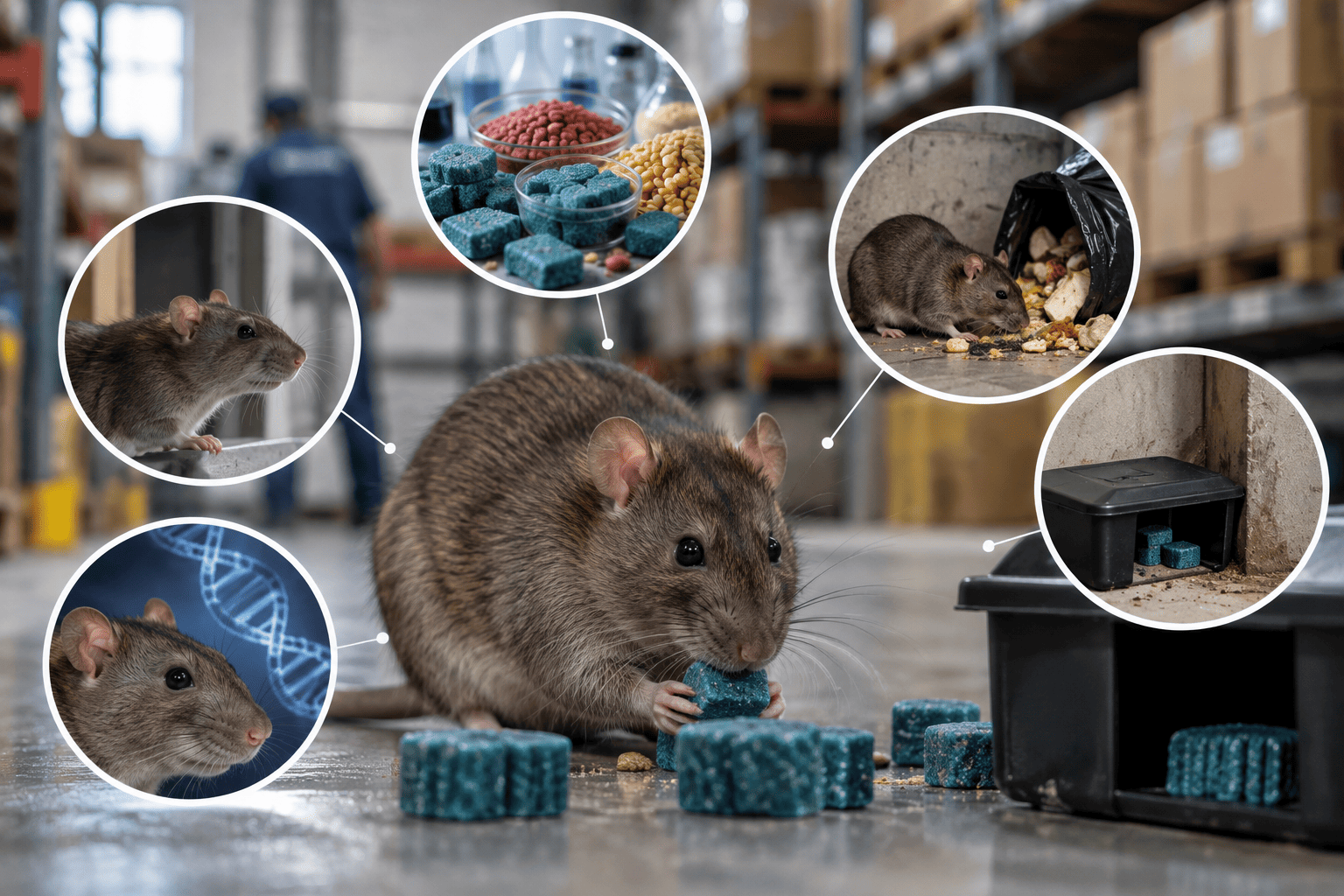
Rodenticides are commonly used as part of rodent management programs. However, successful control does not depend solely on the presence of an active ingredient.
Rodenticide effectiveness may also be influenced by bait characteristics, rat feeding behavior, alternative food sources, bait placement, and the susceptibility of the target population. The U.S. Environmental Protection Agency notes that baiting programs may fail when rodenticide bait cannot compete with the rodents’ normal food supply.
Proper placement near feeding, resting, and activity areas is also important. Therefore, rats remaining active after treatment do not automatically indicate that a rodenticide is ineffective.
Table of Content:
- 1. Type and Characteristics of the Active Ingredient
- 2. Bait Palatability and Rat Feeding Behavior
- 3. Availability of Alternative Food Sources
- 4. Bait Placement and Baiting Strategy
- 5. Rodenticide Resistance or Tolerance
1. Type and Characteristics of the Active Ingredient
The first factor is the active ingredient used in the formulation. Different active ingredients may have different modes of action.
Anticoagulant rodenticides, for example, interfere with vitamin K-related processes involved in normal blood coagulation. Several first- and second-generation anticoagulants have been developed for rodent management.
Active ingredient characteristics may influence:
- the required exposure;
- bait consumption;
- onset of effects;
- duration of action;
- potential sublethal exposure; and
- effectiveness against particular rodent populations.
Therefore, simply confirming that a product contains a particular active ingredient is not sufficient to determine the overall performance of the final bait formulation.
Read Also:
Understanding Rodenticide Active Ingredients and How They Control Rats
2. Bait Palatability and Rat Feeding Behavior
A rodenticide cannot perform effectively if the target rodent does not consume enough bait. Bait palatability is therefore an important factor.
Rats can be cautious toward unfamiliar food or objects in their environment. Taste, odor, texture, freshness, and the composition of the food matrix may all influence bait acceptance.
WHO guidance on rodent control emphasizes the importance of using bait that is attractive and acceptable to the target rodent. In some situations, pre-baiting with untreated food may help rodents become accustomed to feeding at specific baiting locations.
For this reason, the development of a rodenticide should consider not only toxicological activity but also whether the target species is likely to consume the formulation.
3. Availability of Alternative Food Sources
The presence of other food sources can strongly influence bait consumption. Rats may ignore a rodenticide bait if more familiar or attractive food is readily available.
EPA guidance states that baiting programs may fail when bait has to compete with rodents’ regular food. Reducing access to those alternative food sources can improve the likelihood that rodents interact with bait placements.
Potential alternative food sources include:
- exposed waste;
- food residues;
- spilled raw materials;
- animal feed;
- stored food products;
- production waste; and
- poorly secured food-storage areas.
Therefore, rodenticide application should normally be integrated with sanitation and environmental management rather than used as a stand-alone solution.
4. Bait Placement and Baiting Strategy
Even an attractive rodenticide bait may produce poor results if it is placed where rats rarely travel. Rodents commonly use established routes between shelter, food, and water.
Bait placement should therefore take into account signs such as:
- droppings;
- gnaw marks;
- runways;
- rub marks;
- burrows; and
- nesting or hiding areas.
EPA guidance recommends placing bait in locations associated with rodent feeding and resting activity. WHO guidance similarly notes that bait placed near burrows, nests, and runways may increase the likelihood that rodents encounter it before reaching other foods.
Bait quantity, spacing, monitoring intervals, and bait condition may also influence the effectiveness of a rodenticide program.
5. Rodenticide Resistance or Tolerance
Resistance is another important factor affecting rodent control. Resistance to anticoagulant rodenticides has been reported in several rodent populations.
One of the best-studied mechanisms involves genetic variation in VKORC1, a gene associated with the vitamin K cycle targeted by anticoagulants. Certain mutations can reduce susceptibility to some anticoagulant compounds, while metabolic mechanisms may also contribute to resistance.
A 2026 study evaluating wild Rattus rattus and Rattus norvegicus populations further illustrates the continuing importance of monitoring anticoagulant exposure and resistance while also considering potential ecological risks to non-target wildlife. However, unsuccessful control should not automatically be interpreted as resistance.
Before reaching this conclusion, it is important to determine whether:
- the bait was actually consumed;
- sufficient bait was available;
- alternative food was present;
- placement was appropriate;
- the bait remained acceptable; and
- the product was used according to its approved instructions.
Does a Higher Rodenticide Concentration Always Mean Better Effectiveness?
Not necessarily, increasing active ingredient concentration does not automatically guarantee better rodenticide performance. A formulation must balance active ingredient concentration with bait acceptance, target-species exposure, product safety, and potential risks to non-target animals.
Anticoagulant rodenticides may also pose ecological concerns because exposed rodents can contain residues that may subsequently be transferred to predators. Recent monitoring continues to identify anticoagulant residues in wild rats and highlights potential secondary exposure of non-target wildlife.
Therefore, rodenticides should always be used according to applicable labels, regulations, and safety procedures.
Why Should Rodenticide Effectiveness Be Tested?
Knowing that an active ingredient has a recognised mode of action does not automatically prove the effectiveness of the final commercial formulation. The food matrix, formulation characteristics, and bait acceptance can influence how much product is consumed by the target rodent.
Appropriate testing can provide data to evaluate:
- target-animal responses;
- bait consumption;
- formulation effectiveness;
- concentration-response relationships;
- performance under defined test conditions; and
- product claims.
Verify Your Rodenticide’s Effectiveness Through Laboratory Testing
Have you developed a rodenticide formulation but still need objective data on its effectiveness against target rats? Don’t rely solely on the active ingredient or formulation claim. Verify rodenticide performance through Efficacy Testing to support product evaluation and development.
Contact IML Testing & Research today and discuss your rodenticide Efficacy Testing requirements with our team!
Author & Editor: Lina
References
Carromeu-Santos, A., et al. (2026). Rats, residues and rodenticide resistance: Hepatic concentration of anticoagulant rodenticides in genetically susceptible wild brown and black rats. Science of the Total Environment, 1014, 181344.
Ishizuka, M., et al. (2008). Pesticide resistance in wild mammals—mechanisms of anticoagulant resistance in wild rodents. Journal of Toxicological Sciences, 33(3), 283–291.
Watt, B. E., Proudfoot, A. T., Bradberry, S. M., & Vale, J. A. (2005). Anticoagulant rodenticides. Toxicological Reviews, 24(4), 259–269.
Buckle, A. P. (2012). Anticoagulant resistance in the United Kingdom and a new guideline for the management of resistant infestations of Norway rats (Rattus norvegicus). Pest Management Science, 69(3), 334–341.
U.S. Environmental Protection Agency. Urban Integrated Pest Management: A Guide for Commercial Applicators. EPA.
World Health Organization. Operational Guidelines on Plague Surveillance, Diagnosis, Prevention and Control. WHO.
World Health Organization. Guidance on rodent control and bait placement. WHO Vector Biology and Control Programme.