5 Differences Between In Vitro and In Vivo Testing You Need to Know

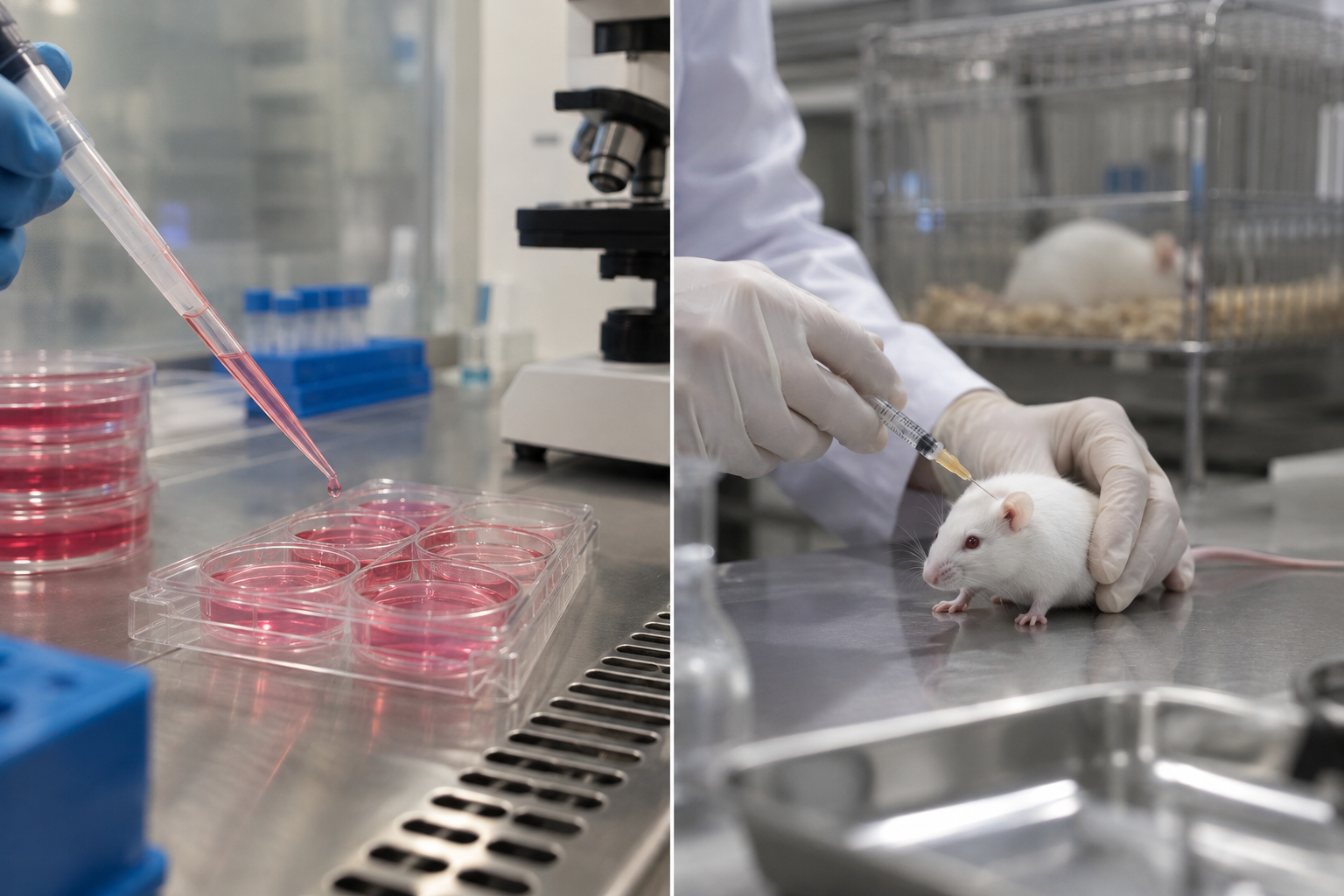
In product development, active ingredient research, cosmetics, pharmaceuticals, and biological studies, the terms in vitro and in vivo testing are frequently used. Both approaches are designed to generate scientific data, but they differ in their experimental models, level of biological complexity, controlled conditions, and interpretation of results.
In simple terms, in vitro testing is performed outside a living organism in a controlled experimental environment. In contrast, in vivo testing involves a whole living organism. The OECD defines in vitro as experimentation conducted in a test tube or, more broadly, in a controlled environment outside a living organism.
In vivo, meanwhile, refers to experimentation using a whole living organism. Understanding these differences is important because one method cannot automatically replace the other.
Here are 5 key differences between in vitro and in vivo testing.
Table of Content:
- 1. Experimental Model
- 2. Biological Complexity
- 3. Control of Experimental Conditions
- 4. Research Purpose and Development Stage
- 5. Interpretation and Relevance of Results
- Is In Vitro Testing Better Than In Vivo Testing?
- Examples of In Vitro and In Vivo Testing
- Why Choosing the Right Testing Method Matters
1. Experimental Model
The first major difference concerns the experimental system.
In Vitro Testing
In vitro testing is conducted outside a whole living organism. Depending on the research objective, the test system may involve:
- cultured cells;
- microorganisms;
- tissues;
- enzymes;
- artificial membranes; or
- other controlled laboratory systems.
This approach allows researchers to investigate a specific biological process or target under controlled conditions. For example, cultured cells may be exposed to different concentrations of an active ingredient to observe cellular responses.
In Vivo Testing
In vivo testing uses a whole living organism. Because the biological system remains intact, researchers can observe responses involving multiple organs, tissues, metabolic pathways, and physiological processes simultaneously.
Therefore, the experimental model is one of the clearest distinctions between in vitro and in vivo testing.
2. Biological Complexity
In vitro systems generally involve a lower level of biological complexity. Researchers can focus on a specific cell type, molecular target, metabolic pathway, or biological mechanism.
This can be useful when the objective is to understand how a substance interacts with a particular target. In contrast, an in vivo system involves a whole organism.
After exposure, a substance may undergo processes such as:
- absorption;
- distribution;
- metabolism;
- interaction with tissues;
- biological transformation; and
- elimination.
These processes can significantly influence the observed response. Therefore, in vivo data may better reflect complex biological interactions, although this complexity can also make results more difficult to interpret.
3. Control of Experimental Conditions
Another key difference involves the degree of control researchers have over experimental variables. In vitro methods generally provide a highly controlled environment.
Researchers may regulate variables such as:
- concentration;
- temperature;
- pH;
- exposure duration;
- cell type;
- nutrient composition; and
- environmental conditions.
This level of control makes in vitro experiments particularly useful for investigating individual mechanisms. In vivo testing, however, involves greater biological variability.
Factors such as physiology, metabolism, age, biological condition, and individual variation may influence the response. For this reason, in vitro and in vivo testing may generate different outcomes even when evaluating the same substance.
4. Research Purpose and Development Stage
In vitro testing is frequently used during early research and development. For example, if researchers have several candidate active compounds, in vitro screening can help identify which candidates demonstrate the most relevant biological activity before moving to additional testing.
The FDA recognizes both in vitro and in vivo approaches as forms of preclinical research that may help researchers evaluate potential toxicity and other characteristics before further development. In vivo studies may then be used when the research question requires information about responses occurring within a complete biological system.
However, there is no universal rule stating that every project must follow exactly the same sequence. The appropriate testing strategy depends on:
- research objectives;
- product characteristics;
- intended endpoint;
- biological relevance;
- regulatory requirements; and
- availability of validated methods.
5. Interpretation and Relevance of Results
One of the most important differences between the two methods concerns data interpretation. In vitro results describe responses within a particular controlled experimental system.
They should therefore not automatically be interpreted as identical to what would occur in a whole organism. This is why scientists use the concept of In Vitro to In Vivo Extrapolation (IVIVE).
The OECD defines IVIVE as the qualitative or quantitative translation of experimental in vitro findings to predict phenomena occurring in vivo. In pharmaceutical research, in vitro–in vivo correlation models have also been developed to investigate whether laboratory measurements can predict biological performance.
Scientific reviews indicate that appropriately designed biorelevant in vitro methods may help predict in vivo behavior, but their predictive ability depends heavily on the experimental model and assumptions used. Therefore, neither result should be interpreted without considering the method, experimental design, and limitations.
Is In Vitro Testing Better Than In Vivo Testing?
Not necessarily. The more useful question is: Which method provides the most appropriate data for the research objective? In vitro testing provides several advantages, including greater experimental control and the ability to study specific biological mechanisms.
It can also be useful for screening multiple materials during early-stage research. In vivo testing, meanwhile, provides information about responses occurring within a complete living biological system.
For many research applications, the two approaches can complement each other. Studies in pharmaceutical development, for example, commonly use preliminary in vitro and other laboratory models before in vivo studies to support candidate selection and understand product behavior.
Examples of In Vitro and In Vivo Testing
The application of these methods varies considerably among industries. In cosmetic research, in vitro models may be used to evaluate specific characteristics of ingredients or formulations through suitable laboratory systems.
In vivo approaches may be used when the endpoint requires assessment within a living biological system, subject to applicable protocols, regulations, and ethical requirements. Sunscreen testing provides one example.
Certain sunscreen properties may be investigated using in vitro approaches, while some SPF determination methods involve in vivo assessment. Toxicological research can also use in vitro models to investigate cellular responses to substances.
However, when the research question involves systemic responses, metabolism, or interactions among multiple organs, other approaches may be necessary. Therefore, the appropriate use of in vitro and in vivo testing depends on the endpoint being evaluated.
Why Choosing the Right Testing Method Matters
Laboratory data are only useful when the testing method can appropriately answer the research question. Selecting an unsuitable method may produce results that are difficult to interpret or irrelevant to the intended objective.
Before selecting a method, researchers should consider:
- the testing objective;
- sample characteristics;
- biological mechanism;
- endpoint;
- method sensitivity;
- reproducibility;
- regulatory requirements; and
- biological relevance.
OECD guidance on good in vitro method practices also emphasizes the importance of appropriate test systems, documentation, trained personnel, procedures, and quality controls in generating reliable laboratory data.
Choose the Right Testing Approach for Your Product
Not sure whether your testing needs require an in vitro, in vivo, or another laboratory approach? Don’t select a testing method based on assumptions alone.
IML Testing & Research helps companies identify relevant testing approaches based on sample characteristics, analytical parameters, and product research or development objectives.
Contact IML Testing & Research today and discuss your Efficacy Testing, Toxicity Testing, Molecular Biology, or Chemical Compound Testing requirements with our team!
Author & Editor: Lina
References
OECD. (2018). Guidance Document on Good In Vitro Method Practices (GIVIMP). Organisation for Economic Co-operation and Development.
U.S. Food and Drug Administration. Step 2: Preclinical Research. FDA.
U.S. Food and Drug Administration. Definitions: Comparison of FDA, EPA and OECD Good Laboratory Practice. FDA.
González-García, I., Mangas-Sanjuán, V., Merino-Sanjuán, M., & Bermejo, M. (2015). In vitro-in vivo correlations: general concepts, methodologies and regulatory applications. Drug Development and Industrial Pharmacy, 41(12), 1935–1947.
Jacob, S., & Nair, A. B. (2018). An updated overview with simple and practical approach for developing in vitro-in vivo correlation. Drug Development Research, 79(3), 97–110.
Váradi, J. et al. (2023). Recent options and techniques to assess improved bioavailability: In vitro and ex vivo methods. Pharmaceutics.
Martínez-Rizo, A. B. et al. (2024). Models in vivo and in vitro for the study of acute and chronic inflammatory activity: A comprehensive review. International Immunopharmacology.