Uncovering the Secrets of Matcha and Green Tea: Are Matcha and Green Tea the Same?


Tea has long been a popular beverage worldwide, including in Indonesia. The demand for tea continues to grow year after year, and in countries like China and India, it has even become the second most consumed drink after mineral water. Scientifically, the tea that dominates commercial tea products on the market comes from Camellia sinensis.
There are three main varieties of C. sinensis, distinguished by environmental conditions, biochemical affinity, leaf size, and leaf position. C. sinensis var. sinensis is the variety most widely cultivated in China, Taiwan, Japan, and several parts of Southeast Asia due to its naturally sweet taste, making it the preferred choice for producing green tea and matcha.
Are Green Tea and Matcha the same?
Although often thought of as the same, green tea and matcha are scientifically different. Green tea can be categorized into Chinese green tea and Japanese green tea, whereas matcha is a type of Japanese green tea that is unfermented and finely ground into powder. The key difference between green tea and matcha lies in their cultivation and processing.
Green tea is grown under direct sunlight, after which the leaves are picked and dried. It tends to have a darker green color, a more bitter and lighter taste, with a slight acidity. In contrast, matcha is grown under shaded conditions before being harvested and stone-ground into a fine powder, resulting in a creamier texture and stronger flavor. Matcha also boasts a brighter green color and a higher concentration of compounds, especially phenolic acids, flavonols, amino acids, and caffeine.
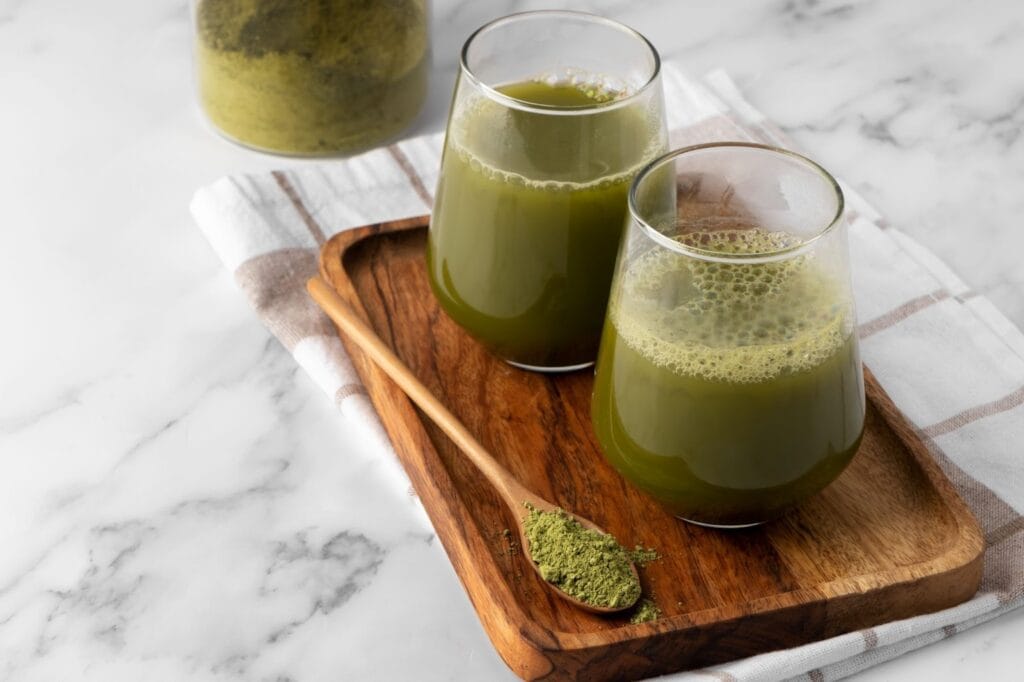
Source: Freepik.com
Differences in Cultivation and Processing
Both green tea and matcha come from the same plant, Camellia sinensis, which is also used to produce other types of tea beverages such as black tea, oolong tea, and white tea. However, their cultivation and processing methods differ significantly. Green tea is cultivated directly under full sunlight, which increases its catechin (EGCG) content, giving it a more astringent or bitter taste.
Meanwhile, its theanine levels are lower since the compound breaks down into polyphenols under sunlight exposure. After harvesting, leaf oxidation is halted during processing using one of two methods: steaming or pan-firing. The leaves are then rolled to break down cell walls, creating the distinctive shape of tea leaves, before being dried and made ready for brewing.
Matcha, on the other hand, is grown under shade by covering the tea plants with nets or mats 20–30 days before harvest, reducing sunlight exposure by 60–98%. This shading stimulates chlorophyll production, giving the leaves a brighter green color compared to green tea leaves. Other biological changes include an increase in the amino acid L-theanine, which provides a rich umami flavor and calming effect, and a reduction in catechin levels.
Shading also alters the photosynthesis pathway by lowering photochemical activity, which triggers increased chlorophyll production. In addition, gene expression associated with the Calvin cycle (carbon fixation), such as Rubisco, decreases, while genes involved in chlorophyll pigment synthesis, such as protochlorophyllide oxidoreductase and Mg-chelatase H, are activated to maximize light absorption.
Both matcha and green tea are healthy, but they offer different experiences. Matcha delivers a smooth umami taste with denser nutrients, while green tea provides a lighter, refreshing flavor. Choose according to your preference—either way, both bring benefits to body and mind.
Ensure your green tea or matcha products meet the highest quality standards. IML Research provides bioactive component assays, product stability testing, and toxicity testing to ensure safety and consistent quality before products are marketed. Maintain your consumer trust with accurate and reliable scientific data. Start testing your products with IML Research today.
Author: Safira
Editor: Sabilla Reza
References:
Chen X, Ye K, Xu Y, Zhao Y, Zhao D. Effect of Shading on the Morphological, Physiological, and Biochemical Characteristics as Well as the Transcriptome of Matcha Green Tea. Int J Mol Sci. 2022 Nov 16;23(22):14169. doi: 10.3390/ijms232214169. PMID: 36430647; PMCID: PMC9696345.
Matcha.com. (2023, July 12). Matcha vs green tea: Matcha powder is better (here’s why +5tips). Tersedia: https://matcha.com/blogs/news/matcha-vs-green-tea-matcha-powder-is-better-heres-why-plus-5-tips
Zhao, X., Gao, X., Li, Y., … & Zhou, C. (2023). Differences in phytochemical profiles and antioxidant activities of green tea and matcha: A comparative study. Food Research International, 172, 113203. https://doi.org/10.1016/j.foodres.2023.113203