Lab Tests Prove Honey’s Potential as a Natural Therapy for Canker Sores


- What Are Canker Sores and Why Do They Occur?
- Common Types of Canker Sores
- Symptoms and Characteristics of Canker Sores
- Why People Seek Treatment for Canker Sores
- How Honey Works as an Antioxidant and Antibacterial Agent
- Honey’s Anti-inflammatory and Wound Healing Effects
What Are Canker Sores and Why Do They Occur?
Aphthous stomatitis, commonly known as canker sores, is a common condition characterized by small, painful white ulcers inside the mouth. Canker sores consist of benign ulcers that recur on the oral mucosa.
The exact cause remains unknown; however, this condition is thought to involve a combination of various factors, including a weakened or impaired immune system, food allergies, oral trauma, poor nutrition, certain medications, family history, and others. Canker sores usually begin in childhood, and most patients are under 30 years old. As people age, the frequency of occurrence gradually decreases.
Common Types of Canker Sores
In general, canker sores can be classified into three types.
1. Minor aphthous ulcers
Minor aphthous ulcers, which are the most common, usually less than 8 mm in size. They typically appear on the inner lips or sides of the tongue and heal within about 10 days.
2. Major aphthous ulcers,
Major aphthous ulcers, which can exceed one centimeter in size. These often affect the palate or throat mucosa and may sometimes be accompanied by fever.
3. Herpetiform aphthous ulcers
Herpetiform aphthous ulcers, which are often mistaken for lesions caused by herpes infection. They are characterized by numerous small ulcers that may merge into larger ones, lasting up to two weeks. For some individuals, aphthous stomatitis occurs occasionally, while in others, it may recur up to four times a year.
Symptoms and Characteristics of Canker Sores
Canker sores rank among the most common oral cavity diseases. Statistically, they affect 5–66% of the general population. Symptoms and severity vary among individuals. The initial symptom is usually a burning sensation, followed by the appearance of ulcers within 1 to 2 days.
Symptoms are generally limited to the oral mucosa; however, canker sores may sometimes be associated with systemic symptoms such as fever or malaise. They almost always develop on soft tissues, such as the inner lips, inner cheeks, tongue, floor of the mouth, soft palate, and throat. The ulcers are typically round, oval, or shallow spots with a grayish-yellow center and a red border.
Why People Seek Treatment for Canker Sores
Canker sores are rarely a sign of a serious disease, but they can be very uncomfortable. They require time to heal. Generally, they resolve spontaneously within 1 to 2 weeks, though more severe cases may take over a month to heal.
Although canker sores are usually not dangerous, many people seek treatment for them. The goal of treatment is to relieve symptoms, speed up healing, and reduce the severity of the ulcers. Treatments may involve medical or natural remedies. This article will discuss honey as an alternative option for treating canker sores.
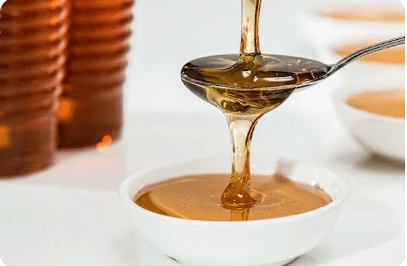
Honey is a natural sweet liquid produced by honeybees from the nectar of flowers or other parts of plants. Bees collect nectar and then process it in the hive with special enzymes, resulting in honey that is rich in sugars, enzymes, vitamins, minerals, and antioxidants.
How Honey Works as an Antioxidant and Antibacterial Agent
In general, honey is a mixture of various compounds such as polyphenols, ascorbic acid, carotenoids, organic acids, enzymes, and other proteins, all of which contribute to making honey a nutritional source with antioxidant properties. Honey exhibits strong antioxidant activity and is capable of reducing the effects of oxidative reactions that generate free radicals and reactive oxygen species (ROS).
In addition, honey is also known to have significant antibacterial effects, which are related to its physicochemical properties, such as high osmolarity due to its high sugar content and low pH caused by the presence of organic acids. The activation of glucose oxidase enzymes when honey is diluted also triggers the formation of hydrogen peroxide from glucose metabolism, thereby creating conditions unfavorable for bacterial growth and development, while also potentially supporting wound healing.
Honey’s Anti-inflammatory and Wound Healing Effects
The combination of honey’s antioxidant and antibacterial effects further contributes to its anti-inflammatory properties, by suppressing excessive inflammation and thereby supporting the wound healing process. Since the presence of ROS is known to trigger inflammation, honey’s antioxidant activity also helps reduce excessive inflammatory responses. Its ability to prevent bacterial infection by creating an environment unsuitable for microbial growth further strengthens its anti-inflammatory effects.
Moreover, the application of honey to wounds has been shown to stimulate the production and release of pro-inflammatory cytokines such as interleukin-1 and tumor necrosis factor-alpha, which play important roles in wound healing. Topical application of honey on injured tissues has also been demonstrated to accelerate tissue repair by stimulating epithelial cell growth, reducing edema, and promoting wound debridement.
By understanding how canker sores develop and how honey works through its antioxidant, antibacterial, and anti-inflammatory mechanisms, we can see that honey's effectiveness is not just a mere claim. In fact, these benefits can be further proven through proper laboratory testing to ensure its quality and safety before use as an alternative treatment.
You can schedule a free consultation with the IML Research team to determine the most appropriate lab test for your product. Our team of experts is ready to help you understand the relevant testing parameters. Ensure the quality of your product is verified with accurate and reliable test results.
Author: Jihan
Editor: Sabilla Reza
References:
Hennessy B.J. 2025. Recurrent Aphthous Stomatitis. MSD Manual Consumer Version. Available from : https://www.msdmanuals.com/home/mouth-and-dental-disorders/symptoms-of-oral-and-dental-disorders/recurrent-aphthous-stomatitis
Hunter M, Kellett J, D’Cunha NM, Toohey K, McKune A, Naumovski N. The Effect of Honey as a Treatment for Oral Ulcerative Lesions: A Systematic Review. Explor Res Hypothesis Med. 2020;5(1):27-37. doi: 10.14218/ERHM.2019.00029.
Plewa MC, Chatterjee K. 2023. Recurrent Aphthous Stomatitis. In: StatPearls [Internet]. Treasure Island (FL): StatPearls Publishing; 2025 Jan-. Available from: https://www.ncbi.nlm.nih.gov/books/NBK431059/