It’s Not the Shampoo’s Fault! Here’s the Scientific Reason Your Hair Is Falling Out


- Addressing Hair Loss from the Root of the Problem
- Understanding the Hair Growth Cycle
- The Role of Hormones in Hair Loss
- Finasteride: Inhibits DHT Formation
- Minoxidil: Extending the Hair Growth Phase
- Hair Loss Solutions Can Be Found
Addressing Hair Loss from the Root of the Problem
Hair loss is a common issue that can affect both men and women. For some individuals, this condition may lower self-confidence, as it can lead to hair thinning or even baldness. Additionally, fallen hair often ends up scattered on the floor or clinging to clothing, which can be bothersome or uncomfortable for many people. To address hair loss, there are various practical steps that can be taken, one of which is the use of synthetic compounds formulated to reduce hair fall. This article discusses the problem of hair loss, from its causes to potent compounds that may help manage the condition.
Understanding the Hair Growth Cycle
Hair loss is closely linked to the hair growth cycle, which consists of three phases: anagen, catagen, and telogen. The anagen phase is the period of active hair growth, with approximately 90–95% of scalp hair follicles in this stage. The catagen phase is a short transitional phase when hair growth stops, involving less than 1% of follicles. Finally, the telogen phase is the resting phase when hair is no longer growing and will naturally fall out, with about 5–10% of follicles typically in this phase. If the percentage of follicles in the telogen phase exceeds the normal range—for example, reaching 25–30%—this may result in excessive hair loss of more than 100 strands per day, a condition known as telogen effluvium.
The Role of Hormones in Hair Loss
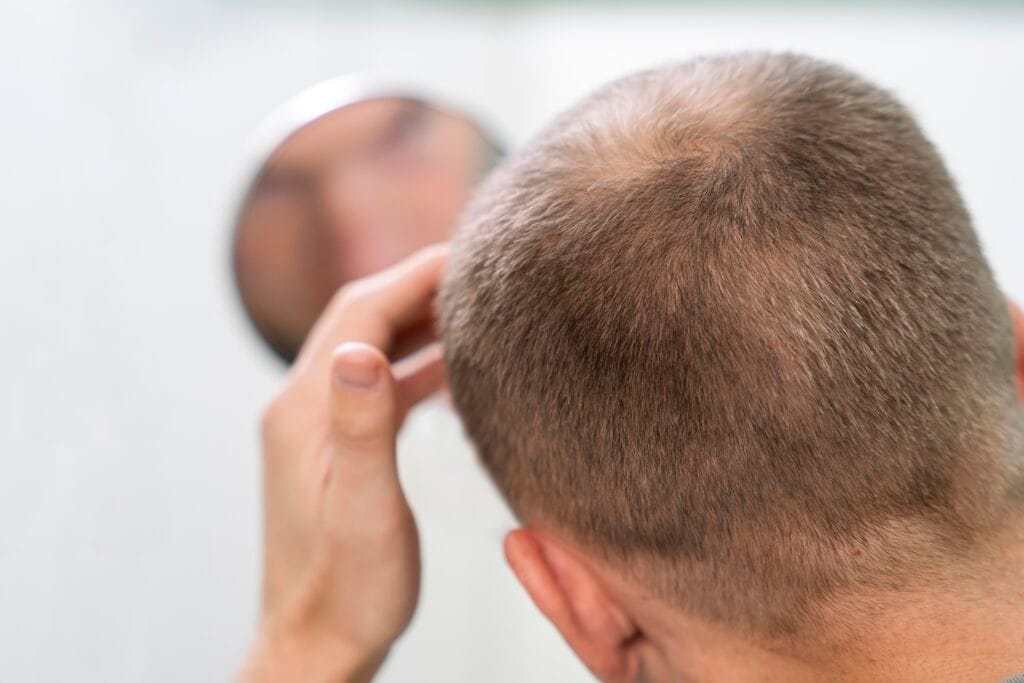
In individuals who inherit certain genes, the primary trigger of hair loss can be influenced by androgen hormones, which cause the shrinking of hair follicles—a condition known as androgenetic alopecia. These androgen hormones bind to androgen receptors in hair cells and convert large, healthy follicles into small, weakened ones. Over time, as the hair growth cycle repeats, the anagen (growth) phase becomes progressively shorter. The most significant androgen involved in this process is dihydrotestosterone (DHT), which is formed by the enzyme 5α-reductase, primarily type II, converting testosterone into DHT in the scalp.
Finasteride: Inhibits DHT Formation
In relation to this hormone, finasteride, a competitive inhibitor of 5α-reductase type II, can help prevent hair loss in individuals predisposed to androgenetic alopecia. This compound competes with testosterone to bind to the 5α-reductase type II enzyme, thereby preventing the conversion of testosterone into DHT, and has been shown to reduce DHT levels by approximately 60%. As DHT levels decrease, hair loss can be mitigated. However, finasteride is contraindicated for use in pregnant women or those who may become pregnant, as DHT plays a crucial role in the development of male fetal genitalia. Inhibiting DHT during pregnancy may result in abnormalities in the external genitalia of male fetuses.
Minoxidil: Extending the Hair Growth Phase
In addition to finasteride, minoxidil also plays a role in preventing hair loss by prolonging the anagen phase and enlarging miniaturized hair follicles affected by hormonal or other factors. The effectiveness of minoxidil has been demonstrated in clinical trials, which showed a significant improvement in hair growth compared to subjects who received a placebo.
Aside from genetically driven, hormone-related hair loss, several other factors can contribute to hair shedding. These include physical or emotional stress, nutritional deficiencies, the use of certain medications, and immune system disorders. Therefore, it is strongly recommended to consult a healthcare professional to determine the underlying cause of your hair loss before using any compound or medication. This ensures that the treatment is both effective and safe, minimizing the risk of significant side effects.
Hair Loss Solutions Can Be Found
Understanding the exact cause of hair loss isn’t just a matter of guessing whether it’s hormones or stress; it also requires scientific evidence that can be proven through laboratory testing. By testing the active ingredients and compounds in hair care products, laboratories can ensure the safety, effectiveness, and stability of formulations before products are used or marketed. At IML Research, comprehensive and accurate testing is conducted to help brands and researchers understand how ingredients work on the hair and scalp.
Reliable test results are essential for developing hair care products that are safe, effective, and compliant with regulatory standards. Want to ensure your hair care product formulations are truly effective and safe? Come and have laboratory testing at IML Research and create products your consumers can rely on.
Author: Devira
Editor: Sabilla Reza
Reference:
Price, V. H. (1999). Treatment of hair loss. New England Journal of Medicine, 341(13), 964-973. https://doi.org/10.1056/NEJM199909233411307.