5 Facts About Mosquito Coils: From How They Work to Strategies Efficacy Testing

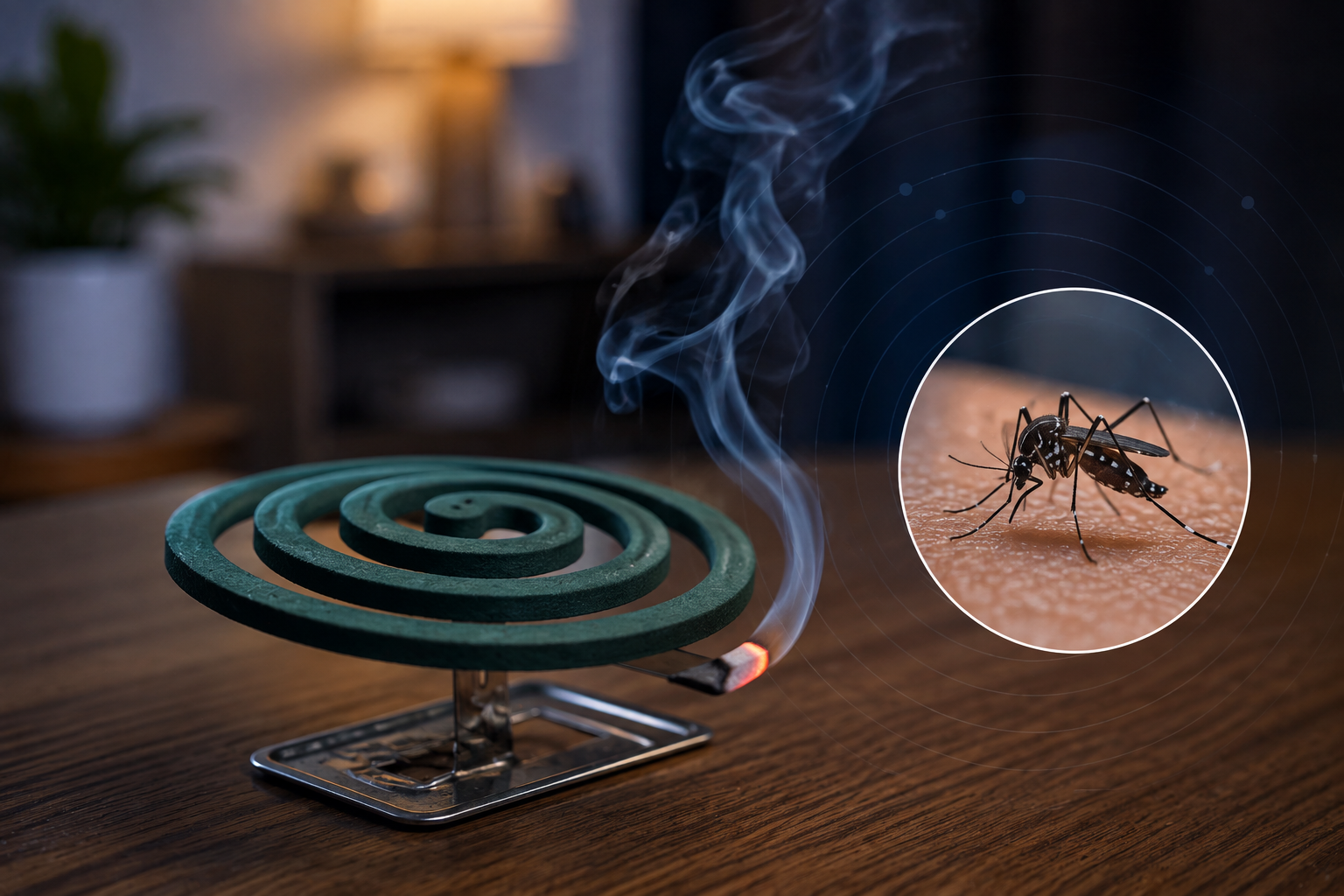
Mosquito coils remain a commonly used method for helping control mosquitoes in and around residential environments. These spiral-shaped products work by gradually releasing active ingredients into the surrounding air as they smolder.
Although mosquito coils may appear simple to use, their effectiveness can be influenced by several factors. The active ingredient, formulation, burning characteristics, environmental conditions, and mosquito species can all affect product performance.
So, how do mosquito coils actually work, and how can manufacturers determine whether their products perform as intended? Here are five important facts about mosquito coils.
Table of Content:
- Mosquito Coils Release Active Ingredients During Burning
- Active Ingredients Can Affect the Mosquito Nervous System
- Knockdown and Mortality Are Different Parameters
- Effectiveness Depends on More Than Active Ingredient Concentration
- Efficacy Testing Helps Evaluate Product Performance
Mosquito Coils Release Active Ingredients During Burning
Once the tip of a mosquito coils is ignited, the coil continues to smolder slowly. This process releases active ingredients into the surrounding air together with volatile components and combustion products.
Many mosquito coil formulations use pyrethroids as their insecticidal active ingredients. Pyrethroids are synthetic insecticides developed based on the structure and insecticidal activity of naturally occurring pyrethrins.
The released active ingredient can then reach mosquitoes within the exposure area. However, the presence of an active ingredient alone does not establish how effectively the final product will perform.
Read Also:
How Mosquito Spray Works: How Insecticides Kill Mosquitoes Effectively
Active Ingredients Can Affect the Mosquito Nervous System
Pyrethroids primarily act on voltage-gated sodium channels in the insect nervous system. Disruption of these channels can produce abnormal nerve activity, potentially resulting in knockdown, paralysis, and eventually mortality depending on the dose and exposure.
Some active ingredients used in mosquito-control products may also influence mosquito behavior, including their interaction with or presence within a treated area. Therefore, evaluating mosquito coil performance does not necessarily mean observing mortality alone.
Knockdown and Mortality Are Different Parameters
When evaluating insecticidal products, knockdown and mortality should not be treated as identical endpoints. Knockdown refers to a condition in which exposed mosquitoes can no longer fly or move normally following insecticide exposure.
This response may occur relatively quickly. Mortality, on the other hand, refers to mosquito death after a defined observation period.
A mosquito showing a knockdown response may not necessarily die immediately. Monitoring responses at appropriate observation times can therefore provide more complete information about the performance of a formulation.
Effectiveness Depends on More Than Active Ingredient Concentration
The concentration of an active ingredient is important, but it is not the only factor that determines mosquito coil effectiveness. Performance may also depend on the type of active ingredient, overall formulation, burning rate, release and distribution of the active ingredient, environmental conditions, test-room characteristics, ventilation, exposure duration, mosquito species, and insecticide susceptibility.
Insecticide resistance is another important consideration. Mosquito populations with resistance to particular pyrethroids may respond differently from susceptible populations. Therefore, two mosquito coil products containing apparently similar active ingredients do not necessarily provide identical performance.
Efficacy Testing Helps Evaluate Product Performance
If active ingredient concentration alone cannot demonstrate effectiveness, how can mosquito coil performance be evaluated objectively? This is where efficacy testing becomes important.
Efficacy testing evaluates mosquito responses following exposure to a product under defined methods and conditions. Depending on the study objective and protocol, evaluated parameters may include knockdown, mortality, time-related responses, and other relevant biological endpoints.
Testing provides objective data about how the final formulation performs against the intended target organism. Manufacturers can therefore evaluate their products using experimental performance data rather than relying solely on theoretical assumptions or active ingredient concentration.
From Active Ingredients to Measurable Efficacy
A mosquito coil may appear simple when used, but its performance involves interactions between its active ingredient, formulation, burning process, exposure conditions, and the biological response of mosquitoes. Product development should therefore go beyond selecting an insecticidal active ingredient.
Efficacy testing provides an important link between product formulation and measurable performance against the intended target organism.
Has Your Mosquito Coil Been Evaluated for Efficacy?
IML Testing & Research provides efficacy testing services to help companies evaluate the effectiveness of mosquito-control products against target organisms using relevant testing approaches. For manufacturers, brand owners, and R&D teams developing mosquito coils or other insect-control products, efficacy testing can provide valuable data for evaluating and improving formulation performance.
Consult with IML Testing & Research to discuss an appropriate efficacy testing approach based on your product characteristics and target organism.
Author & Editor: Lina
References
World Health Organization. (2009). Guidelines for Efficacy Testing of Household Insecticide Products: Mosquito Coils, Vaporizer Mats, Liquid Vaporizers, Ambient Emanators and Aerosols. WHO Pesticide Evaluation Scheme (WHOPES), Geneva.
Zaim, M., Aitio, A., & Nakashima, N. (2000). Safety of pyrethroid-treated mosquito nets. Medical and Veterinary Entomology, 14(1), 1–5.
Soderlund, D. M. (2012). Molecular mechanisms of pyrethroid insecticide neurotoxicity: Recent advances. Archives of Toxicology, 86, 165–181.
Davies, T. G. E., Field, L. M., Usherwood, P. N. R., & Williamson, M. S. (2007). DDT, pyrethrins, pyrethroids and insect sodium channels. IUBMB Life, 59(3), 151–162.
Liu, W., Zhang, J., Hashim, J. H., Jalaludin, J., Hashim, Z., & Goldstein, B. D. (2003). Mosquito coil emissions and health implications. Environmental Health Perspectives, 111(12), 1454–1460.
Achee, N. L., Bangs, M. J., Farlow, R., Killeen, G. F., Lindsay, S., Logan, J. G., Moore, S. J., Rowland, M., Sweeney, K., Torr, S. J., Zwiebel, L. J., & Grieco, J. P. (2012). Spatial repellents: From discovery and development to evidence-based validation. Malaria Journal, 11, 164.