Don’t Just Scrub: Clinical Reasons Why Body Scrub Must Pass Skin Irritation Tests

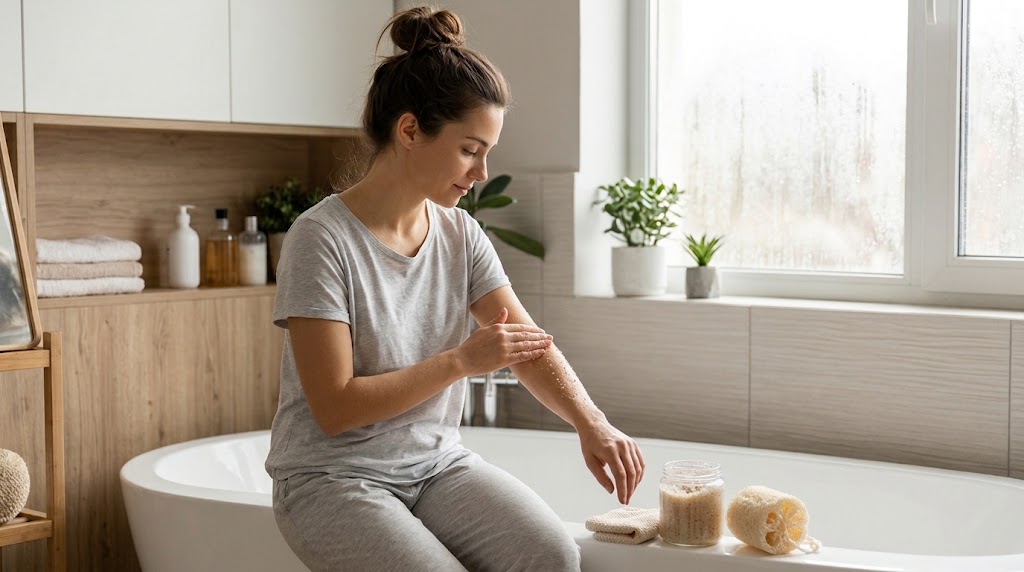
The use of a body scrub has become a crucial element in modern consumer personal care routines, driven by the promise of removing dead skin cells, correcting hyperpigmentation, and revealing a smoother skin texture. However, beneath these promising marketing claims of instant results, mechanical exfoliation carries highly significant clinical risks if the formulation is not precisely calibrated.
As a cosmetic manufacturer or brand owner, you cannot rely solely on subjective perception or unstandardized internal trials. Exfoliating formulations must undergo rigorous clinical testing to scientifically prove that the product does not trigger cellular-level inflammation.
Table of Content:
- The Anatomy of the Stratum Corneum and the Impact of Mechanical Friction
- The Hidden Danger: Chemical Penetration Through Micro-Tears
- Clinical Manifestations: From Erythema to Contact Dermatitis
- The Necessity of Clinical Laboratory Validation (Patch Testing)
The Anatomy of the Stratum Corneum and the Impact of Mechanical Friction
The outermost layer of human skin, the stratum corneum, serves as the primary defense shield (the skin barrier). This layer features a distinct “brick-and-mortar” structure, where dead skin cells (corneocytes) are tightly bound together by a lipid matrix consisting of ceramides, cholesterol, and free fatty acids.
The abrasive particles within a body scrub whether derived from natural sources like sugar, sea salt, coffee grounds, crushed walnut shells, or synthetic microbeads are specifically designed to create direct friction against this stratum corneum. If the size, angular morphology (shape), and concentration of these particles are poorly formulated, the resulting mechanical friction does more than just slough off dead skin cells; it actively tears away the protective lipid layer.
This aggressive process creates invisible micro-tears, severely compromising the structural integrity of the skin barrier and significantly accelerating Transepidermal Water Loss (TEWL).
Read Also:
Over-Facial Exfoliation: Its Impact on Skin Health and How to Choose the Right Products
The Hidden Danger: Chemical Penetration Through Micro-Tears
The most critical risk associated with aggressive body scrub application does not stop at mechanical wounding. A body scrub formulation inherently consists of a suspension base that contains various chemical substances, ranging from cleansing agents (surfactants like Sodium Laureth Sulfate or Cocamidopropyl Betaine) and preservation systems (such as parabens or phenoxyethanol) to synthetic fragrances and artificial colorants.
When the skin barrier is intact and healthy, these high-molecular-weight chemical substances struggle to penetrate the stratum corneum. However, once mechanical exfoliation creates microscopic lacerations, the gateway to the deeper epidermal layers is thrown wide open.
These potentially irritating chemical substances bypass the skin’s natural defenses, directly penetrating and interacting with Langerhans cells and nerve endings in the epidermis, thereby triggering a violent chain reaction within the localized immune system.
Clinical Manifestations: From Erythema to Contact Dermatitis
When the chemical substances in a body scrub base penetrate through micro-tears, the skin’s immune cells rapidly release pro inflammatory cytokines as a defensive response. Clinically, this acute immune reaction manifests as persistent erythema (redness), intense burning sensations, severe pruritus (itching), and abnormal desquamation (pathological peeling).
In more extreme cases, repeated exposure to an uncalibrated, untested product can lead to the development of Irritant Contact Dermatitis (ICD) or Allergic Contact Dermatitis (ACD), both of which necessitate long-term dermatological medical intervention.
The Necessity of Clinical Laboratory Validation (Patch Testing)
To prevent mass consumer health crises, cosmetic regulatory authorities (such as the FDA or BPOM) strictly require manufacturers to validate their products’ safety profiles. Skin irritation testing, particularly the clinical Patch Test, remains the gold standard for evaluating the primary irritation potential of a body scrub formulation.
In a controlled laboratory setting, product samples are applied directly to a human panelist’s skin under an occlusive patch for a duration of 24 to 48 hours. Board certified dermatologists then objectively score the application sites for any signs of erythema or edema.
This procedure generates quantitative, irrefutable data proving that the body scrub product remains well within established safety thresholds.
Test Your Body Scrub at IML Testing and Research Now!
Stop taking blind risks in your product development cycle. Definitively prove the safety of your exfoliating formulations. Schedule a Patch Test clinical consultation with the expert analytical team at IML Testing and Research.
We deliver precise, highly accurate, and regulatory-recognized clinical data to guarantee your cosmetic formulation is 100% safe, legally compliant, and fully prepared to dominate the market without the risk of regulatory rejection.
Author & Editor: Lina
Reference
Tranggono, R. I., & Latifah, F. (2007). Buku Pegangan Ilmu Pengetahuan Kosmetik [Handbook of Cosmetic Science]. Jakarta: PT Gramedia Pustaka Utama.
Wasitaatmadja, S. M. (1997). Penuntun Ilmu Kosmetik Medik [Guide to Medical Cosmetics]. Jakarta: Universitas Indonesia (UI-Press).
Djuanda, A. (2015). Ilmu Penyakit Kulit dan Kelamin [Dermatology and Venereology] (7th Edition). Jakarta: Faculty of Medicine, University of Indonesia.
Baumann, L. (2009). Cosmetic Dermatology: Principles and Practice (2nd ed.). McGraw-Hill Professional.