Gummy vs. Powder Formats in Children’s Probiotics: Which is More Stable Based on Analytical Testing?

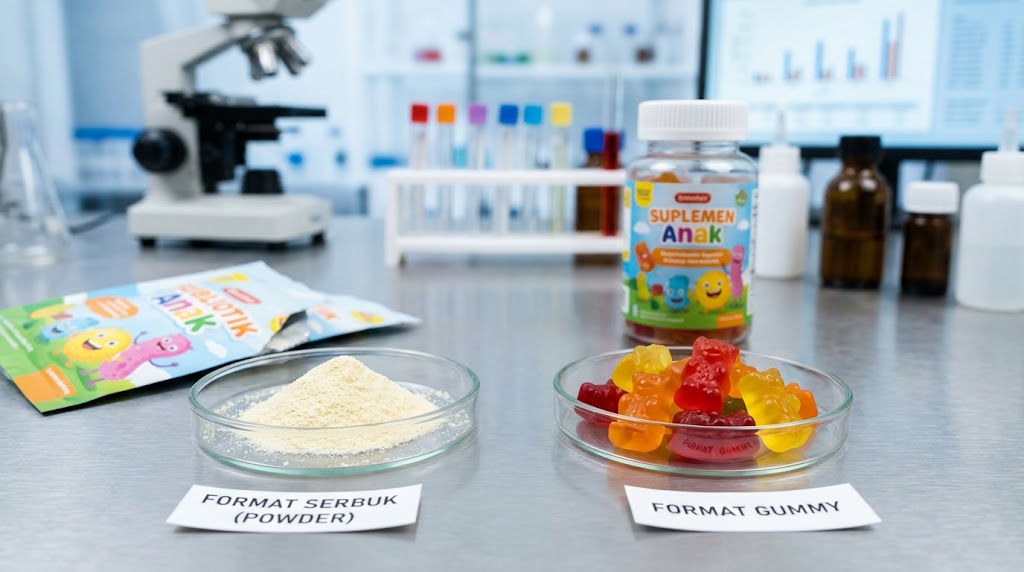
The children’s health supplement trend continues to grow rapidly. Today, parents are looking for a probiotik anak (children’s probiotics) product that not only promotes digestion and immunity but also comes in a taste and format that kids love.
This has sparked formulation innovations in the nutraceutical industry, where gummy and powder sachet formats have become the two most dominating options in the children’s probiotics market. However, for brand owners and factory formulators, choosing a format is not merely about consumer preference
The biggest challenge in producing a children’s probiotics is maintaining the stability of the living microorganism cells within it. Based on analytical laboratory testing results, which of these two formats is superior in preserving the viability of good bacteria?
Table of Content:
- Powder Format: The Champion of Moisture Stability
- Gummy Format: Delicious, but Analytically Challenging
- The Importance of Analytical Validation to Prevent Overclaiming
Powder Format: The Champion of Moisture Stability
From an analytical standpoint, the powder format is by far the most ideal environment for maintaining probiotic stability. Probiotic bacteria (such as Lactobacillus and Bifidobacterium) require an extremely dry environment to remain in a dormant state until consumed.
- Water Activity (Aw): Powders for children’s probiotics generally have a very low Water Activity (Aw), typically below 0.2
- The Advantage: This dry environment prevents the probiotics from activating prematurely, ensuring that cell viability or CFU (Colony Forming Units) counts remain highly stable at room temperature throughout the product’s shelf life.
Read Also:
The Difference Between Probiotics and Prebiotics: Don’t Mix Them Up
Gummy Format: Delicious, but Analytically Challenging
The gummy format is highly favored by kids, but it can be an analytical “nightmare” if not formulated with advanced technology.
- High Heat and Moisture: Gummy manufacturing involves high heat that can kill probiotic cells. Furthermore, the chewy texture of gummies means the product has a relatively high Water Activity (often above 0.5).
- Risk of CFU Degradation: A moist environment triggers probiotics to activate early inside the packaging. Consequently, the bacteria will die off quickly due to nutrient depletion and acid accumulation. Without cutting-edge microencapsulation technology, the CFU count in a gummy probiotik anak can drop drastically within just the first few months of storage.
The Importance of Analytical Validation to Prevent Overclaiming
Packaging claims stating “Contains 1 Billion CFU” must hold true not just when the product leaves the factory, but until the very last day of its expiration date. Making claims without a robust stability data foundation risks BPOM regulatory violations and destroys consumer trust.
Therefore, whether you choose a powder or gummy format for your children’s probiotics product, viability and stability testing at an analytical laboratory must be conducted periodically and precisely.
Does the Good Bacteria Count in Your Children’s Probiotics Match Your Packaging Claim?
Do not let your children’s probiotics product lose its efficacy due to temperature and moisture degradation. Ensure your probiotic cell viability is scientifically tested and validated.
Conduct CFU Enumeration, Water Activity (Aw) Measurement, and Stability Testing (Accelerated & Real-Time) with a trusted independent analytical laboratory, IML Testing and Research. Secure the quality of your supplements and win market trust right now!
References
Setyaningsih, D., & Rahayu, E. S. (2021). Teknologi Enkapsulasi Probiotik dan Aplikasinya pada Produk Pangan dan Suplemen. Yogyakarta: UGM Press.
Harmita. (2022). Analisis Fisikokimia dan Stabilitas Sediaan Farmasi & Suplemen. Jakarta: EGC Penerbit Buku Kedokteran.
Wulandari, R., & Hidayat, M. A. (2023). Pengaruh Water Activity (Aw) terhadap Tingkat Viabilitas Lactobacillus rhamnosus pada Sediaan Suplemen Serbuk dan Gummy. Jurnal Ilmu Kefarmasian Indonesia, 21(1), 45-52.
Pratama, Y. E., & Kusuma, W. (2022). Evaluasi Stabilitas Colony Forming Unit (CFU) Probiotik Anak dalam Formulasi Sediaan Gummy dengan Metode Mikroenkapsulasi selama Uji Dipercepat. Majalah Farmaseutik, 18(2), 112-120.
Oktaviani, N., & Suriana, N. (2024). Analisis Penurunan Kadar Probiotik Aktif pada Sediaan Pangan Fungsional Anak Berbasis Jeli Selama Penyimpanan Suhu Ruang. Jurnal Farmasi Sains dan Terapan, 11(1), 22-29.