Organic Fertilizer SNI Quality Standards: Which Test Parameters Must Be Met?

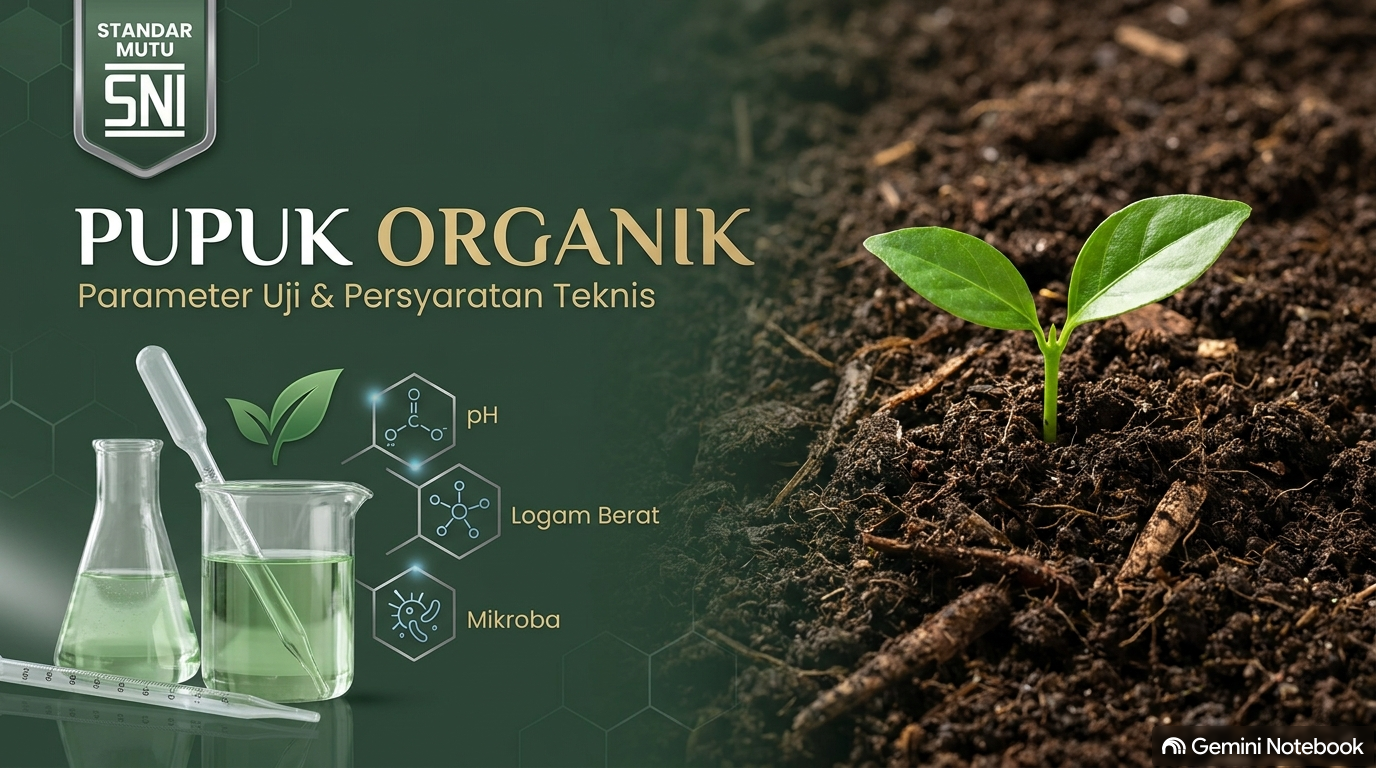
Ever bought organic fertilizer and got results far below what you expected? The problem could be quality. That’s why understanding the SNI quality standards for organic fertilizer matters so much, for producers and farmers alike.
For manufacturers, meeting SNI (Indonesian National Standard) requirements is more than just an administrative formality to obtain a distribution permit; it serves as an absolute guarantee that your product is free from dangerous pathogens and heavy-metal contamination, and that it contains a precise balance of nutrients. Without rigorous analytical laboratory validation, the fertilizers you distribute could damage soil structure, cause crop failure, and trigger regulatory sanctions—potentially destroying the credibility of your agricultural business permanently.
In this article, we’ll go through the main test parameters that serve as the reference for organic fertilizer technical requirements.
Table of Content:
- Organic Carbon and the C/N Ratio
- Moisture Content, pH, and Foreign Matter
- Heavy Metal Limits
- Nutrient Content, Micronutrients, and Pathogenic Microbes
- Why Quality Must Be Maintained
Organic Carbon and the C/N Ratio
Organic carbon (C-organic) shows how much organic matter the fertilizer contains. For solid organic fertilizer, the minimum is 15%. For liquid organic fertilizer, it must be above 10%.
The next parameter is the C/N ratio. For solid fertilizer, the required range is 12–15, which indicates the material has decomposed well. Immature compost can interfere with plant growth.
Read Also:
Liquid Organic Fertilizer Nutrient Testing: Strategies Essential for Manufacturers
Moisture Content, pH, and Foreign Matter
These three physical parameters often decide whether a product passes:
- Moisture content: maximum 35% for solid fertilizer.
- pH: must be above 4 and below 8, for both solid and liquid fertilizer.
- Foreign matter: gravel, glass, and plastic must be below 2%.
Moisture that is too high makes fertilizer spoil easily during storage. Excess foreign matter signals that the raw materials weren’t clean enough.
Heavy Metal Limits
This parameter is about food safety. Heavy metals can be absorbed by plants and eventually reach consumers. The maximum limits are:
- Arsenic (As): below 10 ppm
- Mercury (Hg): below 1 ppm
- Lead (Pb): below 50 ppm
- Cadmium (Cd): below 10 ppm
Organic fertilizer made from municipal waste needs extra attention. Household waste is often mixed with used batteries and cans, which can contaminate the product with heavy metals.
Nutrient Content, Micronutrients, and Pathogenic Microbes
These three parameters must be stated on the label:
- Total N + P₂O₅ + K₂O content
- Micronutrients (Zn, Cu, Mn, Co, Fe) in ppm
- Pathogenic microbes, namely E. coli and Salmonella
For compost, SNI 19-7030-2004 adds several other requirements. These cover maturity, foreign material content, organic contaminants, moisture content, and agronomic value.
Why Quality Must Be Maintained
Organic fertilizer quality isn’t only about product performance. It’s also about legal compliance. The Fertilizer and Pesticide Monitoring Guidelines (Ministry of Agriculture, 2020) set out sanctions for registration holders who fail to guarantee quality. These range from a written warning to product recall if the warning isn’t answered within 10 days.
The registration number can be revoked if no improvement is made within 30 days. In addition, Law No. 22 of 2019 provides criminal penalties for distributing fertilizer that is unregistered and/or unlabeled.
The penalty is up to 6 years in prison and a fine of up to IDR 3 billion. The figures above come from the cited literature, so always check the latest applicable regulations.
Conclusion
SNI quality standards for organic fertilizer cover chemical, physical, safety, and biological parameters. These include organic carbon, the C/N ratio, moisture content, pH, foreign matter, heavy metals, and pathogenic microbes.
All of them must be proven through laboratory testing, not just claims on the packaging.
Consult Your SNI Organic Fertilizer Testing at IML Testing and Research Today!
Soil-enhancing claims are entirely worthless if your organic fertilizer fails to meet SNI (Indonesian National Standard) requirements. Schedule a fertilizer testing consultation with the experts at IML Testing and Research.
We will design the most precise, rapid, and legally validated agricultural testing parameters to guarantee your organic fertilizer is 100% SNI-compliant and ready to dominate the market.
Author: Fachry
Editor: Lina
References
Kementerian Pertanian. (2020). Pedoman pengawasan pupuk dan pestisida [Fertilizer and pesticide monitoring guidelines].
Purba, T., Situmeang, R., Rohman, H. F., Mahyati, Arsi, Firgiyanto, R., Junaedi, A. S., Saadah, T. T., Junairiah, Herawati, J., & Suhastyo, A. A. (2021). Pupuk dan teknologi pemupukan [Fertilizers and fertilization technology]. Yayasan Kita Menulis.