The 5 Rights of Fertilization: Strategies for Less Wasted Fertilizer and Better Harvests

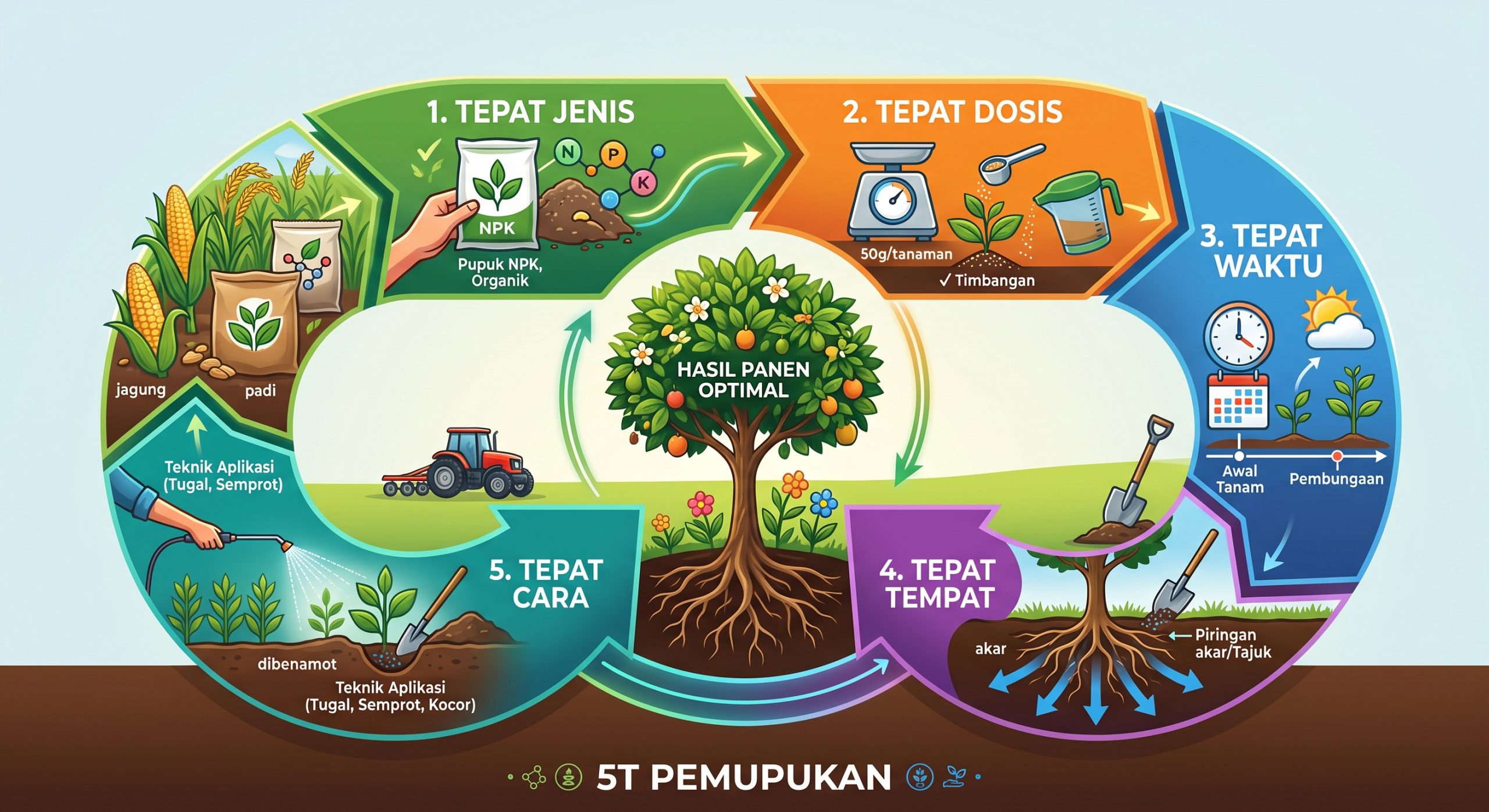
Ever feel like you've been fertilizing diligently, yet your plants still aren't giving you the results you expect? The problem might not be a lack of fertilizer, but how it's being applied. In agriculture, there's a principle known as the 5 Rights of Fertilization (5T) — five conditions that must be met so the fertilizer given to plants is actually absorbed instead of going to waste. Let's break them down one by one.
Table of Content:
1. Right Type
Every fertilizer has a different nutrient content, physiological reaction, solubility, and rate of action. If a plant is deficient in nitrogen, apply Urea. If it's deficient in phosphorus, use SP-36.
Choosing the wrong type of fertilizer won't help the plant thrive — it can actually stunt its growth. Therefore, effective fertilization requires understanding that the value of a fertilizer is determined by several properties: its nutrient content, hygroscopicity (its ability to absorb water), solubility, acidity, and salt index.
Read Also:
Why Plants Remain Unhealthy Even After Fertilization. 7 Facts!
2. Right Dose
This one matters a lot too — the amount applied has to be just right, neither too little nor too much. Too little, and the plant's nutrient needs won't be met. Too much, and the plant can suffer from toxicity, essentially an overdose.
So before beginning the fertilization process, it's worth checking the plant's actual needs and the soil's fertility condition.
3. Right Time
When fertilizer is applied also determines how effectively the nutrients are absorbed. Fast-reacting fertilizers are best applied after planting, or split into 2-3 applications since they're easily washed away by water.
Slow-acting fertilizers, on the other hand, can be applied all at once before planting. The best time to fertilization is generally in the morning, when the soil is moist — not dry, but not waterlogged either.
4. Right Place
The location and placement of fertilizer also affect how well it's absorbed. For example, on elevated, windy land, spraying liquid fertilizer clearly isn't ideal since it can easily blow away.
Proper placement — whether broadcast, placed in furrows, or buried near the roots — can make nutrient uptake far more effective.
5. Right Method
Finally, the application method itself has to be correct so fertilizer doesn't go to waste. Some common methods include:
- Broadcasting — suitable for densely planted crops like rice.
- Sideband placement — commonly used as a starter fertilizer, for example on chili peppers.
- In-the-row placement — used for crops such as sugarcane and corn.
- Foliar application — fertilizer is dissolved and sprayed directly onto the leaves.
- Fertigation — fertilizer is delivered through irrigation water, commonly used in hydroponic systems.
Choosing the wrong application method can cause fertilizer to be lost to runoff or evaporate before the plant has a chance to absorb it.
Conclusion
In short, applying the 5 Rights of Fertilization — right type, right dose, right time, right place, and right method — is the key to making sure the fertilizer given to plants isn't wasted. When these five principles are followed correctly, plants can grow optimally, harvest yields improve, and fertilizer costs become more efficient.
Precision Fertilization Starts with High-Quality Fertilizer!
To be even more confident that your fertilizer or soil meets the required nutrient standards, it's worth having it checked through laboratory testing. Make sure your fertilizer quality and soil condition are verified at IML Research and Testing so your 5-Rights strategy is more accurate and delivers maximum results!
Contact our expert team today for a free consultation!
Author: Fachry
Editor: Lina
References
Mansyur, N. I., Pudjiwati, E. H., & Murtilaksono, A. (2021). Pupuk dan Pemupukan. Syiah Kuala University Press.
Purba, T., Situmeang, R., Rohman, H. F., Mahyati, Arsi, Firgiyanto, R., Junaedi, A. S., Sa'adah, T. T., Junairiah, Herawati, J., & Suhastyo, A. A. (2021). Pupuk dan Teknologi Pemupukan. Yayasan Kita Menulis.
Slamet, S. (2019). Lima Tepat (5T) dalam Aplikasi Pemupukan. KATAM Terpadu Modern, Kementerian Pertanian.