The Utilization of Arbuscular Mycorrhizal fungi (AMF) in Enhancing Biopesticide Production from Neem Trees


Did you know that neem trees contain compounds that can control pests without polluting the environment? One such compound is azadirachtin, found in neem seeds, which has become the primary ingredient in plant-based biopesticides that are increasingly favored in organic farming.
But how can we naturally increase the azadirachtin content without using additional chemicals? One promising answer lies in the use of Arbuscular Mycorrhizal Fungi (AMF)—soil microorganisms that enhance the plant's ability to absorb nutrients and produce higher levels of bioactive compounds.
- What are Arbuscular Mycorrhiza Fungi (AMF)?
- Can Arbuscular Mycorrhizal Fungi (AMF) Enhance Biopesticide Production from Neem Trees?
What are Arbuscular Mycorrhiza Fungi (AMF)?
Arbuscular Mycorrhizal Fungi (AMF) are soil microorganisms that form mutualistic symbioses with most terrestrial plants. AMF represent one of the most widespread land symbioses, present in 70–90% of terrestrial plant species, and are primarily formed by fungi from the phylum Glomeromycota.
AMF spores in the soil germinate and infect the plant’s root system, forming specialized structures called arbuscules within root cells. These arbuscules serve as the primary sites for nutrient exchange between the plant and the fungus.
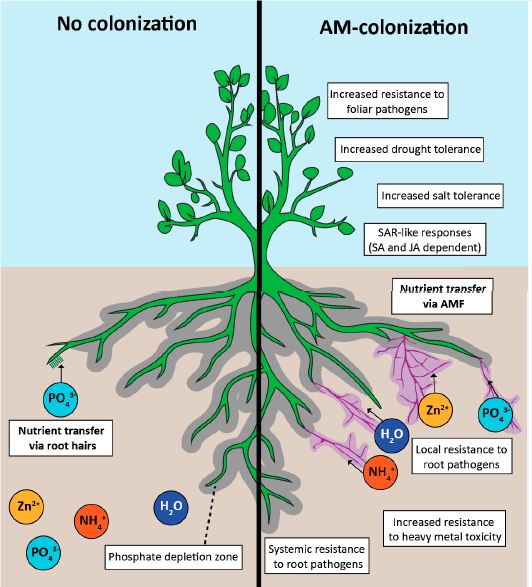
Sumber: Jacott et al, (2017). Trade-offs in arbuscular mycorrhizal symbiosis: disease resistance, growth response and perspective for crop breeding. Agronomy, 7(75).
The fungal hyphal network can extend over 100 meters per cubic centimeter of soil, effectively absorbing nutrients—especially phosphate—and water. In return, the fungus receives carbohydrates produced by the plant through photosynthesis.
The neem tree (Azadirachta indica) is known to be highly dependent on mycorrhizae. Various AMF species have been found colonizing neem roots under natural conditions, with Glomus fasciculatum and Glomus mosseae being the most commonly found.
Inoculation with these fungi has been proven to enhance growth, quality, and nutrient uptake in neem seedlings under both sterile and non-sterile soil conditions. Recent studies show that AMF symbiosis not only improves plant growth but also stimulates the biosynthesis of economically valuable secondary metabolites.
In neem trees, AMF have been shown to increase the production of active compounds like azadirachtin, which are essential for biopesticide applications. Enhancing the levels of such compounds is vital, as it directly impacts the effectiveness of neem as a natural biopesticide.
Can Arbuscular Mycorrhizal Fungi (AMF) Enhance Biopesticide Production from Neem Trees?
The neem tree is well-known for its wide range of benefits, particularly in agriculture and medicine. One of its key bioactive compounds is azadirachtin, a natural substance that acts as a potent botanical biopesticide.
Azadirachtin disrupts the hormonal systems and growth of pest insects, making it widely used in eco-friendly biopesticides. Due to its non-toxic nature to humans and minimal environmental impact, it serves as a crucial alternative for organic pest control.
The production of azadirachtin in neem trees is influenced by various factors, including soil conditions, nutrient availability, and interactions with microorganisms. One of the most important microbial partners in this context is AMF.
Studies have shown that inoculating neem trees with AMF, such as Glomus fasciculatum, enhances nutrient uptake and boosts the plant’s metabolic activity. Although this may not always result in increased plant height or stem diameter, the presence of AMF significantly affects the production of secondary metabolites, including azadirachtin.
The observed increase in azadirachtin content in neem seeds inoculated with AMF indicates that these fungi can activate specific metabolic pathways involved in azadirachtin biosynthesis. Similar effects have also been seen in other medicinal and aromatic plants that form symbiotic relationships with AMF.
As the azadirachtin content increases, so does the quality and effectiveness of neem seeds as raw material for botanical biopesticides. This makes the application of AMF a valuable strategy in the sustainable cultivation of neem with high economic potential.
In summary, the relationship between AMF and neem trees not only supports early plant growth but also plays a crucial role in increasing the content of bioactive biopesticide compounds such as azadirachtin. Integrating AMF inoculation techniques into neem cultivation systems can be a key strategy to support the development of a sustainable, eco-friendly, plant-based biopesticide industry—an increasingly important alternative to chemical pesticides.
Read more:
3 Recommended Pesticide Lab Tests to Pass the Ministry of Agriculture’s Distribution Permit!
Want to ensure the effectiveness of your natural biopesticide?
IML Research provides bioactive compound assays, toxicity tests, and efficacy tests to ensure the scientifically proven azadirachtin content, safety, and performance of your neem-based biopesticide. Contact the IML Research team for comprehensive, accurate, and reliable test results for your neem-based product development.
Author: Dherika
Editor: Sabilla Reza
References
Sessoms, F. (June 4th, 2020). Arbuscular Mycorrhizal Fungi: Tiny Friends with Big Impact. Retrieved from https://turf.umn.edu/news/arbuscular-mycorrhizal-fungi-tiny-friends-big-impact (Accessed: August 6th, 2025).
Smith, S. E., & Read, D. J. (2008). Mycorrhizal Symbiosis. London: Academic.
Venkateswarlu, B., Pirat, M., Kishore, N., & Rasul, A. (2008). Mycorrhizal Inoculation in Neem (Azadirachta indica) Enhances Azadirachtin Content in Seed Kernels. World J Microbiol Biotechnol, 24, 1234-1237.